Scooters, markets, and endless surprises—welcome to Saigon, a city that will steal your heart (and probably your appetite). Curious? My blog shows you why.
Disclaimer: All views expressed on this blog are my own based on my own experiences and do not represent of any entity with which I have been, are now or will be affiliated.
June 19, 2025
Batangas, Philippines
Date of Trip: May 23-25 and 27
Ho Chi Minh City, formerly known as Saigon, is Vietnam’s largest metropolis and a vibrant cultural and economic hub. While it is no longer the capital—that title now belongs to Hanoi—it remains one of the most historically rich and fascinating cities in Southeast Asia. Saigon was the capital of South Vietnam until the end of the Vietnam War in 1975, after which it was renamed in honor of revolutionary leader Ho Chi Minh. Today, the city pulses with life, blending modern skyscrapers with French colonial architecture and remnants of its complex past.
Until recently, I had never set foot in Ho Chi Minh City, and I was excited to finally experience the dynamic pulse of the South. I had heard so much about its fast-paced lifestyle, deep historical roots, and vibrant street culture—but being there in person was something else entirely. Like every other destination I’ve explored in Vietnam, it exceeded my expectations in its own unique way.
This trip came about spontaneously, and since I had been planning to visit Laos, I thought—why not make a quick stop in Saigon first? After all, Vietnam continues to be the country I feel most drawn to in Southeast Asia. It’s easily my favorite country in Southeast Asia, and any chance to return feels like coming back to somewhere familiar yet always full of surprises.
How to Plan a Trip to Saigon?
Visa Requirements
Philippine passport holders could stay up to 14 days “visa free” in Vietnam. But before traveling to Vietnam, make sure that your passport is valid for at least 6 months.
I booked a round-trip flight from Singapore to Ho Chi Minh City, flying out with VietJet Air and returning with Scoot. The total cost came to PHP 6,993.33—PHP 3,851.72 for VietJet and PHP 3,141.61 for Scoot. Both flights operated on standard 3-3 seat configurations and included no checked baggage, in-flight meals, or onboard entertainment—just a 7kg carry-on allowance, which worked fine for a short trip.
Note: There are direct flights from the Philippines to Ho Chi Minh City operated by Cebu Pacific, AirAsia, and Philippine Airlines. However, this leg of the journey was a spur-of-the-moment addition to my Singapore trip, which is why I chose to fly out from Singapore instead.
Travel Insurance – I already had travel insurance as part of my earlier trip to Singapore — something I never travel without. For longer trips (which mine usually are), I consider it essential. I purchased mine through the GCash app from Standard Insurance Co., Inc. for around PHP 903. It covers things like trip cancellations and delays of over six hours, which brings me peace of mind. If you’re planning a trip, I highly recommend checking it out directly through the app for full policy details.
Tan Son Nhat International Airport (SGN) is the main airport serving Ho Chi Minh City, located about 6–8 km from the city center—a 20 to 30-minute drive, though traffic during rush hour can significantly delay travel, so plan accordingly.
Unlike some modern airports, Immigration at SGN is still manually processed, with officers checking passports and visas by hand. This often leads to long queues, especially when multiple international flights arrive. It’s best to arrive at least 3 hours before departure. Please note that for Vietnam passport holders they have egate where they can scan their passports.
The airport has a decent range of food options on both landside and airside, offering a mix of Vietnamese and international fare. That said, prices are on the higher side, typically listed in USD, though Vietnamese Dong (VND) is also accepted—so having some local currency is helpful.
Helpful Travel Tips & Reminders
1. Print your boarding pass — even if you’ve checked in online.
I highly recommend getting a physical copy of your boarding pass printed at the airline counter. I presented a digital version on my phone during my trip back to Singapore, but the Immigration officer refused to accept it. I had to return to the airline counter, queue again, and get it printed — a hassle that could have been avoided. While I haven’t tried printing it myself on regular paper, I still suggest using the airline’s printing service, especially at Tan Son Nhat Airport, where long lines at Immigration and check-in counters are common. A small oversight like this can easily turn into a frustrating delay.
2. Watch for gate changes.
Flight gates can change due to delays or other operational reasons, so always keep an eye on the flight information screens throughout the terminal.
3. Mind your liquids when flying carry-on only.
If you’re not checking baggage, make sure your toiletries are all under 100ml. I sometimes forget to switch out my full-sized bottles when traveling light, and this nearly caused issues when I flew from Singapore to Ho Chi Minh.
4. There is no arrival or departure card required upon entry or exit—no physical forms or e-cards need to be presented.
Currency – Vietnamese Dong. 1000 VND = 2.18PHP
Accessing Cash Abroad – When I travel internationally, I always use my GCash Debit Card to withdraw money from local ATMs. It’s a convenient and reliable option. Just keep in mind that withdrawal fees depend on the bank you’re using. For example, at Agribank ATM just outside the airport, the fee is around 50,000VND(about 109.45PHP) per withdrawal. The good thing is that GCash itself doesn’t add any extra charges — you’ll only pay the ATM fee charged by the international bank, not by GCash or your home bank.
ATMs – ATMs are widely available throughout Ho Chi Minh, so accessing cash is generally not a problem.
Safety – Ho Chi Minh feels generally safe. I often walked around the city at night and never experienced any rude or unpleasant behavior. That said, it’s always wise to stay alert and exercise caution, just as you would in any unfamiliar place.
Time zone – +7GMT
Internet Connection – I bought an eSIM via Klook for PHP 1,338, which gave me unlimited data across four Southeast Asian countries for 9 days, including Singapore and Ho Chi Minh. I really enjoy using eSIMs because all you have to do is scan a QR code before your flight, and you’re instantly connected once you land. Super convenient! I did not encounter any difficulty connecting to the Internet in Vietnam.
Power Socket – uses Type A sockets, which have two flat parallel pins. Many outlets are universal, meaning they can accommodate a variety of plug types — including Type A, B, C, and G — making it convenient for most travelers to charge their devices without an adapter.
Weather – tropical and has two distinct seasons: dry season usually last from March to August, while wet season lasts from September to February.
Transportation – Getting around Ho Chi Minh City is easy with options like taxis, motorbikes, and buses readily available. I personally relied heavily on the Grab app for both taxis and motorbike rides. It’s a convenient and budget-friendly option—especially in Vietnam, where Grab fares are noticeably cheaper compared to other countries. For example, I once booked a 15-minute motorbike ride within the city for as little as 30PHP, making it an efficient and affordable way to get around.
Things to Note: Cars in Vietnam are left-hand drive, meaning the steering wheel is on the left side, and vehicles drive on the right side of the road.
Mode of Payment – Cashless payments are widely accepted in Vietnam, especially in cities like Ho Chi Minh. Most restaurants, cafes, and shops accept cards or mobile payment apps. However, it’s still a good idea to carry some cash and a debit card, as smaller vendors or local markets may not support digital payments.
Convenience Stores – Vietnam has a wide range of convenience stores, with K-mart and 7-Eleven being a common sight, especially in urban areas like Ho Chi Minh City. What surprised me, though, was spotting G25, a convenience store brand originally from South Korea. It turns out that South Korean investment in Vietnam has grown significantly over the years, particularly in retail, food, and real estate. As a result, it’s not unusual to see Korean brands like G25 and Lotteria, a popular Korean fast-food chain, operating across the country. This influence reflects the strong economic and cultural ties between the two nations.
Accommodation – For most of my travels around Asia, I’ve booked accommodations through Agoda, Airbnb, Trip.com, or Booking.com. The platform I use usually depends on where I’m going and the kind of experience I’m looking for.
For this particular trip, I chose Agoda. The process was quick and easy — just enter your destination (in this case, Ho Chi Minh) and browse through a variety of available stays.
I stayed at 9 Hostel and Bar in District 1 for 5 nights, and the total cost was just PHP 1,387—such a great deal! For the first 3 nights, I stayed in an air-conditioned 8-bed female dormitory, then switched to a 6-bed air-conditioned female dormitory for the last 2 nights.
I genuinely enjoyed my stay. The hostel offers luggage storage and bed curtains, which give you a bit of added privacy—a nice touch in a shared space. I preferred the 6-bed dorm during the last part of my stay since I had a bottom bunk. Earlier, I was on the top bunk, where the power outlet was inconveniently located, making it difficult to charge my devices. I also noticed that the storage locker in the 8-bed room was smaller than the one in the 6-bed dorm.
The beds and pillows were comfortable, which made for restful nights. As for the bathrooms, the first shower I tried had extremely hot water with no way to adjust the temperature, but I later found a better shower area with more manageable settings. Thankfully, the toiletries were regularly restocked—though on my first day, there was no shower gel, likely due to high demand from weekend backpackers.
A few important notes: there is no elevator, so it’s best to bring a backpack instead of heavy luggage. The reception is open 24/7, and they’re helpful if you arrive early or need to store your bags before check-in or after checkout.
One of the highlights of staying at the hostel was the restaurant located on the ground floor. They serve authentic and flavorful Vietnamese dishes at very affordable prices. As a bonus, guests receive a 10% discount, which made it even more tempting—I ended up eating there often! The food and drinks were consistently delicious, and I highly recommend trying it if you’re staying at the hostel.
Day1
May 23, 2025 (Friday)
I left my place around 10:00 AM and took a taxi to Changi Airport Terminal 3 for my flight to Ho Chi Minh City. Since I wasn’t able to check in online, I headed straight to the check-in counter to get my boarding pass. Luckily, I had packed light with only a carry-on, so there was no need to check in any luggage. As expected, Changi Airport’s process was smooth and efficient—no delays or long lines, which made everything stress-free.
Before heading to the departure gate, I stopped by the food stalls on the 2nd floor for an early lunch. I had a meal at King of Fried Rice and grabbed a Kopi C and a water chestnut drink from a nearby drink stall. The food hit the spot, though the Kopi C wasn’t quite to my taste—but overall, it was a satisfying meal before my flight.

My flight departed on time at 1:05 PM (SGT), and I landed in Ho Chi Minh City at 2:30 PM (local time). It had just finished raining when we arrived, so the air was fresh and a bit cooler. After deplaning, the airport bus took us to the terminal, where I proceeded through Immigration—a bit of a wait, but nothing too long.
Once cleared, I booked a Grab ride and made my way to my hostel to check in and start my adventure in Vietnam.
Eats from the Trip:
1. Trung Nguyen Legend
2. Bep Me In
3. Saigon Oi
Places on My List:
1. Saigon Opera House
2. The Apartment Building
3. Saigon Skydeck
4. Hostel Restaurant
Trung Nguyen Legend
Price Range: 50,000–100,000 VND
After checking into my hostel, I went in search of a much-needed caffeine fix—especially in a city like Ho Chi Minh, where Vietnamese coffee is a must. Conveniently, there was a Trung Nguyen Legend café right across from my hostel, so I decided to give it a try.
I ordered their signature Vietnamese drip coffee for 185,000 VND (404 PHP), and paired it with a banana crêpe drizzled with honey for 35,000 VND (around 76 PHP). As expected, the coffee was bold, rich, and aromatic—that strong, distinctive flavor that makes Vietnamese coffee so unforgettable. The banana crêpe reminded me of the ones we have back in the Philippines—comforting and familiar.
It was a perfect little break to relax, enjoy the café atmosphere, and ease into my first day in Ho Chi Minh. A great start to the trip!


Bep Me In
Price Range: 50,000–100,000 VND
One coffee wasn’t enough, so I decided to walk around and came across Bep Me In, a Michelin-recommended restaurant I found on Google Maps with excellent reviews. True to the charm of many eateries in Ho Chi Minh, the entrance was tucked away down a narrow alley—you’ll often need to weave through corners and side streets to find these hidden gems.
The restaurant doesn’t have an air-conditioned dining area, so you’ll be seated either alfresco or in a room with ceiling fans. I chose to sit outside and enjoy the lively street ambiance.
I ordered a ca phe sua dua (Vietnamese iced coffee with milk) for 59,000 VND (₱129) and the banh xeo tom (Vietnamese savory pancake with shrimp and pork) for 199,000 VND (₱435). And wow—the coffee was fantastic, strong and refreshing, and the bánh xèo was easily the best I’ve ever had! Perfectly crispy, packed with flavor, and incredibly satisfying. Every bite hit all the right notes.
If you’re in Ho Chi Minh, this place is a must-try. Delicious food, authentic atmosphere, and great value.

Saigon Opera House
I had planned to watch the O Show (Vietnamese Bamboo Circus), a stunning performance that showcases the cultural richness and everyday beauty of rural Vietnamese life, set against the backdrop of the country’s rapidly urbanizing landscape. I initially thought the show was held daily, but it turns out performances are only scheduled on specific dates each month. Unfortunately, there were no shows during the dates I was in Vietnam. It’s best to check their official website here in advance to see if the show aligns with your travel dates in Saigon.

The Cafe Apartments
Price Range: 50k to 100k VND
The Cafe Apartments is a well-known multi-story building in Ho Chi Minh City, famous for its eclectic mix of cafés, boutiques, and small shops tucked into what was once a residential apartment block. While exploring the city on foot, I came across this unique spot and decided to check it out.
Upon entering, I discovered there’s a small elevator fee of 3,000 VND (around 6PHP) to access the upper floors—up to the 8th. I chose to walk up to the 4th floor, browsing the various shops along the way. Each level has its own charm, with cozy, creatively designed spaces that give the building a distinct artsy and vintage vibe.
While I appreciated the experience and the concept, I personally didn’t feel it was a place I’d revisit often on future trips. Still, it’s definitely worth a quick stop if you’re nearby and curious about one of Saigon’s more Instagrammable and quirky landmarks.

Saigon Oi
Price Range: 30k to 100kVND
Located on the 5th floor of The Cafe Apartments, I tried a set meal that included banh mi and coconut coffee for 150,000 VND (328PHP). I chose to sit alfresco, with a nice view overlooking the street and the city below—it was definitely a visually appealing spot.
However, I have to admit the food didn’t quite meet my expectations. While the atmosphere was charming and photogenic, the flavors fell flat compared to what you’d find at more authentic eateries outside the building. For me, it felt more like an aesthetic experience than a culinary one.
It’s a nice place to visit once for the experience or photos, but I personally wouldn’t go out of my way to return.

Saigon Skydeck
Entrance Fee: 240,000VND (525PHP)
Operating Hours: Monday to Sunday 9:30am-9:30pm
I’ve come to realize that even though skydecks aren’t usually at the top of my travel plans, I often find myself visiting them whenever I explore a new city. There’s something about seeing a place from above that gives a fresh perspective—and in Ho Chi Minh City, the Bitexco Financial Tower Skydeck is the perfect spot for that.
Located on the 49th floor, the Saigon Skydeck offers a 360-degree panoramic view of the city’s vibrant landscape—from the winding Saigon River to the maze of streets below. It’s a great way to appreciate the scale and energy of the city from a peaceful, elevated viewpoint.
Just like when I visited the Sapporo TV Tower in Japan, I made sure to take a photo here as a travel keepsake. It’s become a bit of a personal tradition—collecting memories from high above every city I visit. The photo area is located right on the ground floor, just before you take the elevator up to the sky observation deck.


Hostel Restaurant
50k VND to 100kVND
I definitely ate a lot today—one stomach isn’t enough in Ho Chi Minh City, I swear I need five! haha For dinner, I had a classic Southern Vietnamese dish: com tam (broken rice) with grilled pork chop for 120,000 VND (262PHP), paired with a cold Coke.
At first, I was curious about the rice—it looked different from the long grains I’m used to back home. It was shorter, softer, and broke apart easily. That’s because com tam is made from broken rice grains, and interestingly, it has a rich cultural history unique to Southern Vietnam, particularly Ho Chi Minh City.
Historically, com tam dates back to the late 19th century in the Mekong Delta, where it was originally considered a dish for poor farmers. During tough harvest seasons, they had limited access to whole rice grains, so they made do with the broken fragments produced during the milling process. These broken grains were steamed and served as a filling meal. Over time, what started as a humble necessity became a beloved street food staple—so much so that broken rice is now deliberately produced to make this dish.
Today, cơm tấm is a culinary highlight of Ho Chi Minh City, often served with grilled pork, a fried egg, pickled vegetables, and a side of fish sauce. It’s one of those meals that tells a story—with every bite, you’re tasting a piece of Vietnam’s history.
P.S. What I loved most about the hostel’s restaurant was how it let you enjoy that quintessential Vietnam moment—sitting on stools by the street, letting time slow down as motorbikes pass by. It’s such a relaxing and authentic experience.

Day2
May 24, 2025 (Saturday)
Places on My List:
1. Cu Chi Tunnel
2. Mekong Delta
Eats from the Trip:
1. A Taste of Saigon
Price: 1,934.74PHP
Airbnb Experience
I booked a Cu Chi Tunnels and Mekong Delta tour through Airbnb Experiences—you can find all the details on their listing here. I was really looking forward to this trip, as the Cu Chi Tunnels are a must-see for anyone visiting Ho Chi Minh City, and I’d seen it on so many travel itineraries.
After enjoying my egg coffee at the hostel, my guide Tu arrived to pick me up at around 7:10 AM. The tour organizers usually communicate via WhatsApp, which serves as their main channel for updates and coordination. That said, they’re quite flexible and accommodating, so you can let them know if you prefer to be contacted through another method.
Sơn Mài Lâm Phát
Our first stop was Sơn Mài Lâm Phát, a handicraft workshop where artisans—many of whom are physically disabled—create beautiful traditional lacquerware. We watched the detailed process of making these pieces and, at the end, had the option to buy from their showroom. It was a meaningful stop that supports the artisans and helps them earn a living.
Cu Chi Tunnel
I was really looking forward to this tour to explore the Cu Chi Tunnels—an incredible underground network built during the Vietnam War, which showcased the extraordinary resilience and ingenuity of the Vietnamese people. These tunnels played a crucial role in the conflict between the North Vietnamese and Viet Cong forces against the American and South Vietnamese troops, allowing the guerrillas to launch surprise attacks, move undetected, and survive despite intense bombings and warfare.
The tunnel system is an astonishing feat of engineering, stretching over 250 kilometers and equipped with living quarters, kitchens, hospitals, and weapon caches—all hidden beneath the ground. Visiting the tunnels gave me a deeper appreciation for the hardships endured and the determination of the Vietnamese people during this brutal war.
I even tried crawling through a section of the tunnels myself, but I only managed about two minutes before getting completely out of breath. The tunnels were incredibly narrow and cramped—definitely not made for someone like me who isn’t very skinny! It gave me a real sense of how challenging life must have been for the soldiers who lived and fought underground.
After visiting the Cu Chi Tunnels, we stopped for lunch by the river before continuing our journey to the Mekong Delta, about two hour drive away.


Mekong Delta
The journey to the Mekong Delta was long, and it drizzled lightly when we arrived, creating a fresh, calming atmosphere. Known as the “Rice Bowl of Vietnam,” the delta is a vast network of rivers, swamps, and islands in southern Vietnam, famous for its rich biodiversity and vibrant river-based culture.
We took a 10-minute boat ride deeper into the delta, passing stilt houses, floating markets, and lush greenery. Along the way, we watched traditional sweet candies being made. Then, we enjoyed a longer boat tour through the winding channels, experiencing daily life on the river and the natural beauty of the area.
Afterward, we sampled fresh tropical fruits and saw a python—some took photos, but I wasn’t a fan. The visit was eye-opening and deepened my appreciation for Vietnam’s culture and history.


A Taste of Saigon
150kVND to 200k VND
Opening hours: 10am-10pm
After completing the tour around 5:30 PM, I walked to A Taste of Saigon, a highly rated restaurant nearby. I ordered Bun Cha Saigon, which includes grilled pork, fried spring rolls, fresh salad, and noodles. While Bún Chả is traditionally a Northern Vietnamese dish, the southern-style version here was equally delicious. I particularly enjoyed the flavorful fish sauce, tender noodles, and fresh mint leaves. Overall, I loved every bite of the meal.

Day3
May 25, 2025 (Sunday)
City Tour via Motorbike
Airbnb Experience
Amount: PHP2300
More info in this link
Places on my List:
1. Tan Dinh Church
2. Notre Dame Cathedral
3. Post Office
4. Burning Monk
5. Secret Bunker
6. Ten Thousand Pagoda
7. War Remnants Museum
Eats from the Trip:
1. Cafe Cheo Leo
2. Hu Tieu Tron Kho
I’ve always enjoyed private tours, and the one I took with Yudan was hands down the best I experienced in Ho Chi Minh City. What made it even more memorable was touring the city by motorbike, which gave it an authentic, local vibe. Yudan’s deep knowledge of the city’s history added so much value to the experience—I genuinely enjoyed every moment.
He picked me up around 6:30 AM, which was perfect timing. The early morning weather was cool and pleasant, making it an ideal start to the day before the city really heated up. I also enjoyed experiencing the city at a relaxed pace, noticing how clean and vibrant it truly is.
Pink Church or Tan Dinh Church
Our first stop was Tan Dinh Church, famously known as the Pink Church—a striking landmark with its pastel-pink exterior and neo-Romanesque design that makes it one of the most photogenic spots in Ho Chi Minh City.
Built in the late 1800s during the French colonial period, it’s not only visually stunning but also one of the oldest Catholic churches in the city. I arrived early in the morning to beat the crowds, and the soft sunlight on the pink façade made the visit even more special.
Since it was a Sunday, a mass was taking place during my visit, so I couldn’t explore the inside. However, when services aren’t ongoing, visitors are welcome to step inside and admire its interior.


Notre Dame Cathedral
Built between 1863 and 1880 by French colonists, this impressive red-brick church is a symbol of Vietnam’s colonial past and religious heritage.
What makes it truly unique is that all the materials were imported from France, including the iconic red bricks from Marseille and stained-glass windows from Chartres. Although the interior has been closed for renovation in recent years, the cathedral’s exterior remains one of the most photographed sites in the city—especially with the statue of the Virgin Mary in front, which locals say once shed a tear in 2005, drawing large crowds.


Saigon Central Post Office
Opening Hours:
Monday to Saturday: 7:30 AM – 6:00 PM
Sunday: 8:00 AM – 5:00 PM
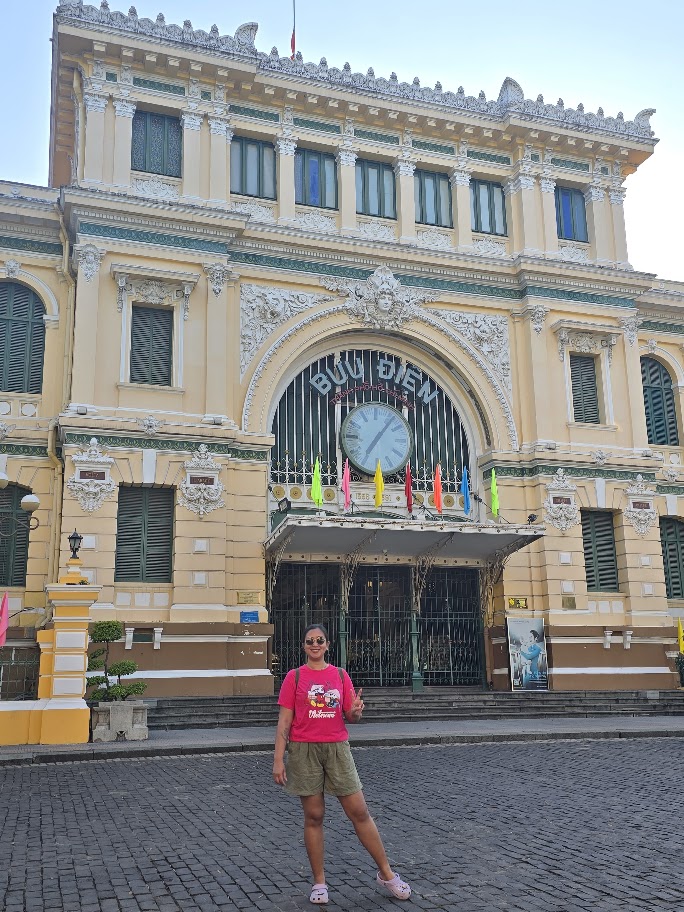
Just a short walk from Notre-Dame Cathedral is the Saigon Central Post Office, one of Ho Chi Minh City’s most iconic landmarks. Designed by French architect Alfred Foulhoux and completed in the late 19th century, the building features beautiful colonial architecture and a stunning interior with arched ceilings and vintage world maps.
It was closed during our first visit, but we visited again around 10am so I could drop off a postcard for Ate Tru’s daughter, Thea. I’ve always loved the idea of sending postcards from every place I visit. Unfortunately, when I tried mailing one from South Korea to the Philippines, it never arrived—likely due to the lack of a reliable public postal system back home, as most services are now privatized.
This time, I was thrilled to hear that Thea actually received the postcard! She was so impressed, and that made the effort even more meaningful. From now on, I’ve decided to make it a travel tradition: send her a postcard from every country I visit—until the day she can explore the world herself.
Note: You can easily purchase postcards and pens inside the post office for a small fee, so there’s no need to bring or buy them elsewhere.


Book Street
Just across from Notre Dame Cathedral and a short walk from the post office is the Book Street—a row of shops selling books, created to encourage young people to read more. You can enjoy a cup of Vietnamese coffee while browsing. When I visited early around 7:00 a.m., the shops were still closed, so I planned to return later before my flight back to Singapore.
Burning Monk Memorial or Thích Quảng Đức Memorial.
One of the most profound and thought-provoking places we visited was the Burning Monk Memorial, dedicated to Thích Quảng Đức, a Vietnamese Buddhist monk. In 1963, during the height of the Vietnam War and under the oppressive regime of South Vietnam’s President Ngô Đình Diệm, Buddhist monks faced severe persecution. Thích Quảng Đức committed an act of self-sacrifice by setting himself on fire at a busy Saigon intersection as a form of peaceful protest against the government’s discrimination and violent repression of the Buddhist community.
His act of self-sacrifice shocked the world and drew global attention to the political and religious turmoil in Vietnam at the time. The iconic photograph capturing the moment he calmly sat in meditation as flames engulfed him became one of the most powerful images of protest in history. It was widely published internationally and was even used as the cover art for the 1992 album by the Rage Against The Machine.
Visiting this memorial is not only a journey into Vietnam’s history but also a powerful tribute to courage, conviction, and the pursuit of justice through peaceful protest. The site is adorned with sala flowers, which symbolize birth, death, rebirth, and hold deep significance in Buddhist tradition.


Secret Bunker
7:30 a.m. to 11:30 a.m. and 1:00 p.m. to 5:00 p.m., Monday to Friday
Free of charge
Tucked beneath a quiet home in District 3, the Secret Weapon Bunker is one of Ho Chi Minh City’s lesser-known but most compelling wartime sites. This underground bunker offers a rare glimpse into the ingenuity and resilience of the Vietnamese during the Vietnam War.
The bunker was built in 1966 by Trần Văn Lai, a former Saigon Ranger and Hero of the People’s Armed Forces. Without telling his family, he secretly dug out a hidden cellar beneath his home to store nearly two tons of weapons—including TNT, C4, rocket launchers, and grenades—for use in the 1968 Tet Offensive. Today, the site is maintained by his son, Trần Vũ Bình.
Used as a covert command center, the bunker was part of a larger underground network that enabled the Viet Cong to move undetected and carry out surprise attacks against American and South Vietnamese forces. The cramped, narrow tunnels give visitors a sense of the harsh conditions faced by those who lived and fought underground.
This site is a powerful reminder of the war between North Vietnam (supported by the Viet Cong) and South Vietnam (backed by the U.S.), and it offers a deeply moving perspective on the courage and resourcefulness of the Vietnamese people. If you’re a history enthusiast or simply curious about Vietnam’s past, the Secret Bunker is an essential stop.


Cafe Cheo Leo
Yudan shared that this was the oldest coffee shop in Ho Chi Minh City, and as part of the tour, we got to enjoy a cup of their signature brew. It completely lived up to my expectations—bold, aromatic, and exactly the kind of strong, flavorful coffee I came to Vietnam for. The richness and kick in every sip were truly unforgettable.

Hu Tieu Tron Kho
50k VND
We stopped for lunch at a spot highly recommended by Yudan, and it absolutely lived up to the hype! Along the way, Yudan shared fascinating insights about the history of Saigon’s cuisine. This dish was truly delicious and definitely a must-try when visiting southern Vietnam or Ho Chi Minh City.
The dish is Hu Tieu Tron Kho, a dry-style noodle dish where the noodles aren’t served in soup but tossed in a savory-sweet sauce. It’s topped with pork, shrimp, fried garlic, fresh herbs, and sometimes quail eggs or liver. Yudan even made the sauce himself, and it was packed with flavor.
It usually comes with a small bowl of hot broth on the side, which you can sip between bites or add to the noodles if you prefer. The flavors are perfectly balanced—slightly sweet, salty, and umami-rich—with a pleasant crunch from fried shallots or peanuts. Light yet satisfying, it’s an ideal meal for breakfast or lunch.
If you want to explore local flavors beyond the usual pho or banh mi, Hu Tieu Tron Kho is a comforting and flavorful choice beloved by locals.
Ten Thousand Buddha Pagoda (Chua Vạn Phat)
We stopped by the Ten Thousand Buddha Pagoda, a peaceful Buddhist temple known for its impressive collection of Buddha statues and rich cultural history. Built in 1959, it provides a calm spiritual escape in the middle of the busy city. While I’m not Buddhist myself and not usually a fan of temples, I still found it interesting to learn about the religion and culture. The pagoda offers a beautiful mix of peaceful atmosphere, unique architecture, and cultural depth. It’s a great place for anyone looking for quiet reflection, a better understanding of Buddhism, or simply a break from the hustle and bustle of Ho Chi Minh City.


War Remnants Museum
Entrance fee 40k VND
We visited the War Remnants Museum in District 3—an emotionally powerful place that challenges you to confront the brutal legacy of the Vietnam War. Established in 1975, it showcases everything from heavy military equipment to recreated “tiger cages”, graphic photo exhibits, and chilling displays on the effects of Agent Orange.
During our tour, I asked Yudan if Vietnamese people still harbor resentment toward Americans. He replied, “Both nations suffered. People today understand the past and wish never to repeat it—they don’t want war.”
Walking through the museum, I was struck by how it doesn’t shy away from history’s horrors—deformities from Agent Orange, atrocities like My Lai, and the trauma of indiscriminate bombings . Yet, amidst the darkness, the museum promotes peace and reconciliation, even hosting content on international solidarity and remembrances of journalists who lost their lives.
I was moved to tears reading a letter written by one of the victims of Agent Orange, addressed to then-President Barack Obama. In her words, she expressed the deep and lasting pain the Vietnam War has inflicted—not just on those who lived through it, but on their children and grandchildren.
What struck me most is how Agent Orange continues to affect generations—even now, the fourth generation still suffers from its devastating health consequences. It’s a heartbreaking reminder of how the effects of war can echo far beyond the battlefield and through time.
Visiting isn’t just educational—it’s profoundly humbling. It underscores the resilience of the Vietnamese people and offers a sobering reminder of the consequences of conflict. If you’re in Ho Chi Minh City and value historical insight and cultural understanding, this museum is an essential stop.


In the afternoon, I went to Vientiane. More info here.
Day4
May 27, 2025 (Tuesday)
I arrived late at night on May 26th and had dinner at the hostel. The next day, I decided to extend my stay for another day to rest since my flight to Singapore wasn’t until 6:15 PM local time. In the morning, I enjoyed Mi Xao Saigon (Saigon stir-fried noodles) at the hostel for 89,000 VND (195 PHP) along with a cup of cà phê sữa đá (Vietnamese iced milk coffee) for 50,000 VND (109 PHP). The noodles were packed with flavor, and the coffee gave me the perfect caffeine boost to start my day.

Book Street
Opens Daily 8:00am-9:00pm
I booked a Grab motorbike to get to Book Street, and I’m glad I did—it was too hot to walk, and the distance was a bit far for that day. When I arrived, I was happy to see the bookstores open. I bought Before the Coffee Gets Cold from one of the shops, and I learned that you get a 20% discount when you dine at any of the cafes along Book Street. Many cafes also have books available, so you can enjoy reading while sipping your drink—a lovely touch for any book lover. From now on, I’ve decided to make it a travel tradition to buy a book from each country I visit, alongside sending postcards—I even started this in Nepal!
After purchasing my book, I enjoyed a coconut coffee and fresh coconut juice before heading back to the hostel to check out.
I left my hostel three hours before my flight, which turned out to be a lifesaver. At the airport, I mistakenly showed my e-boarding pass to Immigration, only to realize I needed a printed copy for the airline check-in line. It was a bit of a scramble, but thankfully everything worked out—I made it to the gate just in time, and my flight departed and arrived in Singapore without a hitch.


As I wandered through the streets of Saigon, I felt like I was peeling back the layers of a city that holds so many stories—some heartbreaking, many inspiring, all of them deeply human. With every corner I turned, I was drawn in further—into its culture, its past, and its people and after returning to the Philippines, I made it a point to dive even deeper into Vietnam’s past. What impressed me most was the incredible resilience of the Vietnamese people—not just in enduring hardship, but in learning from their history and using those lessons to drive their rapid progress. Their hard work and determination shine through every aspect of the city’s growth.
But it’s not just the history that captured my heart—it’s the food, the coffee, the vibrant culture, and the warmth of the people. I’m excited to return someday and dive even deeper into the many wonders Vietnam has to offer, from its bustling cities to its serene countryside. There’s so much more to explore, taste, and experience, and I can’t wait for the next adventure!
Singapore trip travel guide here.
Vientiane travel guide here
Love,
Maria,sometimes,Niskie
Leave a Reply