Seoul adventures, hanbok, and a photography tour plus my tips on visas and travel prep—South Korea is full of food, sights, and amazing people. Curious? Read my blog!
Part1
Disclaimer: All views expressed on this blog are my own based on my own experiences and do not represent of any entity with which I have been, are now or will be affiliated.
December 23, 2024
Batangas, Philippines
Date of Trip – December 06-17
First Part Trip – December 6-9
My itinerary for South Korea trip included the following locations based on provinces: First part Seoul, Gyeonggi-do (Suwon, Yongin and Hanam), Gangwon Province (Nami Island and Garden of the Morning Calm) 2nd part Busan, 3rd part Gyeongju, 4th part Jeju
I initially thought this trip might not happen due to the declaration of Martial law by the now-impeached president of South Korea on December 3rd, which was later retracted just a few hours later (link here). I felt a sense of relief when the statement was retracted, as I wasn’t sure I’d want to go if there was political chaos in the country. However, upon arriving, it felt like nothing had changed. The media’s portrayal of the situation seemed exaggerated, and the reality on the ground was far less dramatic than what had been reported.
I’ve always been fascinated by South Korea, a country that draws so many people for its globally popular K-dramas and K-pop music. While I, too, enjoy watching Korean dramas and listening to K-pop, my motivation to visit went beyond the entertainment. I was eager to immerse myself in the rich tapestry of South Korean life—the food, culture, history, and, most importantly, the people. I wanted to experience the essence of the country in a way that could only be felt in person.
When I finally had the chance to visit South Korea, it completely exceeded all of my expectations. It’s a place I’ve fallen deeply in love with, and I’m certain I’ll return time and time again. The journey wasn’t just about seeing new places—it was about feeling more alive, more in tune with the world, and more inspired by the incredible beauty and depth that travel can offer. South Korea gave me so much more than I ever imagined, from unforgettable moments to a renewed sense of wonder, and I know this is a connection that will stay with me for years to come.
Visa Requirements
Filipino citizens intending to visit South Korea need to obtain either a tourist or business visa. The only authorized visa processing center in Manila for this purpose is the Korea Visa Application Center, located on the 9th floor of the Brittany Hotel in Bonifacio Global City (BGC). The exact address is 9th Floor, Brittany Hotel, 141 Valero Street, Salcedo Village, BGC.
Visa Center Hours & Tips:
The center is open from 9:00 AM to 5:30 PM, Monday to Friday. It’s advisable to go in the morning to avoid long queues, especially since it can get crowded later in the day. Note that the center is closed on both Philippine and Korean holidays, so it’s important to check ahead if you’re planning to go during these times.
Process Overview:
When I arrived after lunch, the place was busy, and I ended up waiting around three hours for my turn. Once my number was called, the process itself was quick and straightforward. For your visa application, make sure to have all the required documents ready. The requirements are listed here. I chose C3 requirements for employed individuals.
Important Details:
- Payment: Only cash is accepted, so be sure to bring the correct amount. The visa processing fee is 900 PHP.
- Passport Surrender: Your passport will be temporarily surrendered for processing. You also have the option to have your passport delivered back to you, which I chose.
Timeline:
It took almost four weeks for my visa to be approved. To check the status of your visa application, you can visit the tracking website provided by the visa center.
Visa Type & Validity:
I received a single-entry visa, which means I must enter South Korea within 3 months of the visa issuance. Once in South Korea, I’m permitted to stay for up to 59 days. Keep in mind the entry and stay periods for your specific visa type.
Make sure to double-check all the requirements and allow plenty of time for processing, as the wait can sometimes be longer than expected.
Flight Amount
I purchased a one-way flight ticket with Cebu Pacific to South Korea (Incheon International Airport) for PHP 5,939.00. This price included a 28kg baggage allowance (PHP 1,200) and a seat selection fee (PHP 600). I chose the exit row front seats, though they were still a bit cramped. Additionally, there was a travel tax of PHP 1,620.
Things to Note:
1. All visitors entering or leaving the Philippines must register at the eTravel website at least 72 hours before their arrival time. When it’s done, guests will get a QR code that they need to either scan or take a picture of and show when they get to the country.
2. Please make sure to bring pen because you need to present arrival card to the Immigrations officer at Incheon.
3. It’s always a good idea to have travel insurance for every trip. I secured travel insurance from Standard Insurance Co. for the entire duration of my trip, costing 808 PHP.
Currency – The exchange rate is currently 1.0 KRW = PHP 0.04. When I travel abroad, I always use my GCash Debit card to withdraw money, as it’s more convenient for accessing funds at convenience stores and ATMs in South Korea. However, please note that the fees per transaction can vary depending on the ATM bank. I found that the maximum amount I could withdraw per transaction was 100,000 KRW, and each withdrawal would incur an additional fee of 6,000 KRW.
Power Socket – The Type C plug (also called the Europlug) which has two round pins 220V
Language – Korean spoken and Hangul is the writing system in Korea.
Weather -South Korea experiences four distinct seasons: spring from March to May, summer from June to August, fall from September to November, and winter from December to February. I visited during winter, in Seoul it dropped to almost -5 degree Celsius butwithout snow.
Time zone -+9 GMT, it is 1 hour ahead in the Philippines
Internet Connectivity -I purchased an e-SIM card from Klook for PHP 2,526.00, which offered unlimited data for 15 days. Please note that this is a data-only e-SIM, so it does not include a Korean phone number for calls or text messages.
Transportation – South Korea has an excellent train system, and they offer a convenient stored-value card that can be used for both public transportation and in convenience stores. I used the T-money card, which can be purchased for 5,000 KRW at convenience stores. However, you’ll still need to load additional funds onto the card at the train station’s electronic machines.
I also used Uber during my trip, which I found much more convenient than hailing a taxi. I had an experience in Myeongdong where a taxi driver asked for a fixed rate instead of using the meter, which was unexpected. Additionally, if you’re arriving late at Incheon Airport, booking an Uber or KakaoTalk ride is necessary, as trains have already been closed. I also encountered a situation where a private taxi driver quoted me 150,000 KRW for a ride, which shouldn’t have been the case. This was a bit surprising, as I’ve never experienced something like this in Southeast Asian countries like Vietnam. It was a valuable lesson, but fortunately, the rest of my experience in South Korea went smoothly. Please use Uber, or be sure to confirm the fare with the driver before getting into a taxi.
KTX Trains/Bullet Trains – South Korea’s bullet trains make intercity travel fast and convenient. I used the KTX when traveling to Busan. It’s best to book your tickets in advance, as trains can sell out quickly—I had to wait for the next available one when tickets were no longer available at the station. Once at the station, check the screens for your assigned car number. Some cars have luggage storage, available on a first come, first served basis.
Naver Map – Google Maps is not available in South Korea due to privacy concerns, so locals rely on their own map apps, such as Naver Map or KakaoTalk Map. During my trip, I primarily used Naver Map. While most of the interface is in Korean, you can easily use ChatGPT or a translation tool to help with navigation.
Papago – I used a translation app whenever I communicated with locals, as there can sometimes be a language barrier. However, the people I encountered were very kind, and I didn’t experience any rude behavior. While I still prefer ChatGPT, I found that Papago is more convenient to use in South Korea.
Convenience Stores – South Korea has numerous convenience stores, including C2, GS25, Emart, and 7-Eleven, many of which are open 24 hours. While most are available around the clock, some stores close at 9 PM, but plenty remain open 24/7.
Lockers – There are lockers in South Korea especially I encountered in train stations but majority of time it’s booked.
Safety- As a solo traveler, I can confidently say that South Korea is a very safe destination. I never experienced any rude behavior; in fact, the locals were always kind and helpful. I also walked around at night, and it felt perfectly safe. Overall, I had a wonderful experience there.
Photo booth – I find it so fun that there are so many photo booths scattered around South Korea where you can simply strike a pose, and your photos are printed automatically once you’re done. I absolutely love it!
Cafes and Chicken Joints– As of February 2019, there are around 87,000 fried chicken stores in South Korea, surpassing the combined total of McDonald’s and Subway locations worldwide. The boom in chicken shops began after the 1997 Asian financial crisis when many laid-off workers turned to opening fried chicken restaurants as a low-cost business option. This led to the widespread popularity of Korean fried chicken, resulting in today’s saturated market.
Similarly, coffee shops are also common across the country, with many retirees opening cafes and chicken shops as a way to stay active and earn income, thanks to the low barriers to entry.
Things to Note:
1. Some restaurants in South Korea, particularly Samgyeopsal places, may have a minimum order requirement of two servings. However, this isn’t the case for all establishments. If you’re dining alone, it’s best to ask the staff beforehand—they’ll gladly let you know if a minimum order applies.
2. The portion size per order is suitable for one person and is not too large, so even if you order for two, you should be able to finish it.
3. The banchan (side dishes commonly served throughout South Korea) can be quite filling on their own. If you’re dining alone, you can let the staff know, and they’ll usually adjust the portions accordingly.
Cashless payments – Most stores, except for those in the market, accept credit cards or other cashless payment methods.
December 05 (Thursday)
NAIA Terminal 3
My flight to South Korea is at night, so I have plenty of time to arrive early at the airport. I plan to be there about three hours ahead, as NAIA International Airport tends to get very busy.
I had dinner at Max’s restaurant, though I wasn’t too impressed with the meal (beef kare-kare which was bland), and then grabbed an iced Americano at Seattle’s Best.
December 06 (Friday)
Day1
Incheon International Airport T1
I arrived at Incheon without any delays, and the airport is about a 45-minute to 1-hour drive from Seoul. Before reaching Immigration and picking up your luggage, you’ll need to take a train inside the airport, which highlights just how massive the airport is. However, I did notice that some stores were closed during my early morning arrival. Despite this, everything went smoothly. When I approached Immigration, I was pleasantly surprised to see that the AI machine greeted me in my language, which I thought was a really cool touch.
Accommodation – STEP INN Myeongdong 1 I stayed for 3 nights in a female dormitory room for PHP 3,845.09. Please note that there are 5 steps to reach the elevator leading to the reception area, but aside from that, the location is very convenient—close to the MRT and shopping district. December 05-06 and December 08-10
I thoroughly enjoyed my stay. The staff were friendly and accommodating, and they offer free luggage storage before check-in and after check-out, which was really convenient. The hostel provides a free breakfast from 7 AM to 10 AM, and the entire place is kept clean. The bathroom and shower areas are separate, and the bed and pillows were comfortable, ensuring a good night’s rest. I also appreciated the abundance of outlets conveniently located by the bedside for easy charging. Overall, I had a fantastic experience and would definitely recommend this hostel.
Itinerary
1. Nami Island
2. Garden of the Morning Calm
Hadongkwan
25K-50K
I had breakfast just a 10-minute walk from my hostel before heading to my first meet-up at Nami Island. I ordered Gomtang for 25,000 KRW, which is a traditional Korean soup made with oxtail, beef, and boiled rice. Gomtang is known for its rich, milky white broth, which is achieved by simmering beef oxtail for 24 hours, creating a nutrient-dense and flavorful soup.
In the Philippines, it’s somewhat similar to rice porridge, but our version is typically thicker and made with chicken or pork, often topped with an egg. While I personally prefer porridge, it was a great experience to try this iconic Korean dish, especially since the restaurant is a Bib Gourmand establishment, known for offering high-quality food. The dish was a bit expensive, but the price is likely due to the restaurant’s Bib Gourmand status.

A Twosome Cafe
4k KRW to 10k KRW
After breakfast near Myeongdong Station, I treated myself to dessert and coffee before heading to the meet-up location at Namsan Yejang Public Parking Lot (near Myeongdong Station Exit 1). I had a slice of cheesecake for 12,000 KRW, which was delicious and satisfying. The coffee and cake filled me up perfectly, leaving me ready and energized for my tour.

Nami Island
I met up with our tour guide and fellow tourists to head to Nami Island. I booked the tour through Klook for added convenience. You can find more details about the voucher here. Nami Island is about 1.5 to 2 hours from Myeongdong by bus. Before arriving, you’ll take a short 5-minute boat ride, and then you’ll be there.
Once on the island, I found it to be incredibly relaxing and peaceful, with restaurants spread throughout the area. It’s also the filming location of the famous K-drama Winter Sonata. While I haven’t seen the drama, I thoroughly enjoyed the beautiful scenery of Nami Island. I had a wonderful time exploring, snacking on boiled sweet potato, s’mores, and sipping on an Americano as I took in the sights.


Dakgalbi and Gamja-jeon
I had a late lunch at a nearby restaurant (unfortunately, I can’t remember the name) located across from the entrance to Nami Island. The meal cost 30,000 KRW, and I ordered dakgalbi and gamja-jeon. I thoroughly enjoyed both dishes.
Dakgalbi is a Korean stir-fried chicken dish that’s spicy, sweet, aromatic, and incredibly comforting. What I really loved was that someone cooked the chicken and vegetables right at the table, stir-frying them until they were perfectly done—this is one of the things I truly enjoy about South Korea.
Gamja-jeon, or potato pancakes, is a savory Korean pancake made from grated or ground potatoes. I had an amazing time tasting these dishes and savoring all the wonderful flavors.
*I only have videos of these dishes
Lighting Festival at Garden of the Morning Calm
After a relaxing day in Nami island, we headed over to the Garden of the Morning Calm for their Lighting Festival which runs from December to March during the winter months, with eco-friendly LED lights illuminating the garden. The event is open from 17:00 to 21:00, and on Saturdays, it lasts until 23:00. I visited on the first day of the festival, and it was truly magical—beautiful, relaxing, and soothing, especially with the perfect winter weather. I loved seeing the lights scattered across the garden, and I also took the opportunity to enjoy some food from the cafes and pick up a few souvenirs. I had a fantastic time at the garden and would highly recommend it to anyone visiting.


We returned to Myeongdong around 10 PM, and I went back to the hostel to grab my things before heading to my next stop—a traditional hanok-style home near Anguk Station where I will be staying for 2 nights.
Since I was traveling with a 28kg suitcase, I decided to just bring my hand carry bag with me to avoid the hassle and fatigue of carrying the heavy luggage around. I left the suitcase at StepInn, as I would be returning after two nights. It turned out to be a great decision.
I took a taxi that charged me a fixed rate of 30,000 KRW, which turned out to be a bad decision. The fare should have only been around 10,000 KRW. Next time, I’ll avoid hailing a taxi and instead use Uber or KakaoT to book a ride.
Accommodation
I booked a hanok near Anguk Station with a hinoki bath via Airbnb here, and it was by far the best accommodation I had in Seoul. I’ve always wanted to experience staying in a traditional hanok house, and this stay exceeded all my expectations. The place was spotless, and I received clear instructions on everything. The floor mattress was incredibly comfortable, and I had a restful sleep despite the chilly -5°C weather outside. It was truly a memorable experience.

December 07 (Saturday)
Day2
Itinerary
1. DMZ
2. Namsan tower
3. Nanta Show
Food Places
1. Neoguri Ramen Shop
2. BHC Chicken
I booked a Klook for this tour as it requires a tour agency and which would be easier to access DMZ. Here is the link
Neoguri Ramen Shop
5k KRW to 10k KRW
I had breakfast around 7 am at Myeongdong Exit No. 9 and came across a ramyeon restaurant where you choose your ramyeon at stalls, select your own toppings, and they prepare it for you for 5,000 KRW. I liked that this pop-up restaurant was spacious, with plenty of tables and chairs. It was a fun experience trying the famous ramyeon in South Korea and immersing myself in their ramen culture. I loved it, as it’s one of their comfort foods, and it’s something you can easily recreate at home.
The Demilitarized Zone (DMZ) refers to a region that serves as a buffer between two opposing forces, with restrictions on military activity. The term is most commonly associated with the Korean DMZ, which is a 250-kilometer (160-mile) strip of land that separates North Korea and South Korea.
Here are some key facts about the Korean DMZ:
1. The DMZ was established after the Korean War (1950-1953) with the signing of the Armistice Agreement in 1953. However, this agreement only ceased active fighting and has not been replaced by a peace treaty, meaning the two Koreas are still technically at war.
2. The DMZ was intended to prevent direct conflict between the two nations. It was meant to provide a buffer zone to reduce the risk of accidental military engagements, but it has become a symbol of division and tension on the Korean Peninsula.
3. While the DMZ itself is supposed to be free of military forces, both North and South Korea maintain heavy military forces just outside it. The Joint Security Area (JSA), located at the Panmunjom village, is a notable site within the DMZ where direct meetings between the two countries take place, and military personnel from both sides are present.
4. DMZ has become a haven for wildlife due to the lack of human activity in the area. The region has seen a resurgence of various species, including endangered animals, since it was established.
5. Parts of the DMZ, such as the JSA and certain observation points, are open for tours, allowing people to witness the stark division between the two countries and learn about the history of the Korean conflict. *Just to note, according to our tour guide, Amy, the JSA is no longer open for tours because a U.S. tourist violated the rules and crossed the border. It was a very bad experience for everyone as all of the tourists involved in the tour were sent back home because of this irresponsible behavior. News link here
Things to keep in mind:
1. There are various cafes in each stop in the DMZ tour so it’s cool and they also accept credit cards.
2. Make sure to bring your passport or another form of identification. Foreign Tourists are required to present their passport, as Korean soldiers will check it before granting entry to the DMZ.
3.Always follow the instructions provided. Some areas do not permit photography. For instance, when we visited the tunnel, we were not allowed to take videos or photos, had to wear helmets, store our belongings in a locker, and undergo security checks.
4.Many locations lie beyond the Civilian Control Line, which means they are not accessible to individual tourists. Panmunjeom is only open to visitors who are part of approved tour groups. For Panmunjeom * Tours for groups (business) and foreigners canceled until further notice. See here for more info.
I met Amy, our tour coordinator for the DMZ tour, and our first stop was the Majang Reservoir Suspension Bridge, the longest towerless suspension bridge in South Korea. Afterward, I enjoyed a lemon tea at a nearby cafe before we headed to Imjingak Peace Park, a place of great historical significance in Korea. The Imjingak Resort showcases various war-related artifacts and features the expansive Pyeonghwa Nuri Park. The resort preserves landmarks such as the Freedom Bridge and the Imjingang Rail Bridge, both remnants from the Korean War, serving as poignant reminders of the past. It also includes a Memorial Hall, memorial monuments, and recreational areas. During my visit, I had the opportunity to see the memoirs of the comfort women from the Korean War, which added an emotional layer to the experience.
We then had a buffet lunch for 15,000 KRW, and I particularly enjoyed the kimchi, stir-fried pork, and rice. To keep warm, I believe I had about four cups of coffee throughout the tour.
Next, we visited the 3rd Tunnel, one of several tunnels built by North Korea with the aim of infiltrating South Korea. Discovered in 1978, it is the third tunnel of its kind and the closest to Seoul, located about 52 km away. The tunnel is 1.6 km long, 2 meters wide, and could accommodate up to 30,000 soldiers moving through it every hour. Before entering, we watched a video on the history of the DMZ and the discovery of the tunnels. We were then asked to leave our personal belongings in lockers outside the tunnel for security reasons.
After exploring the tunnel, we visited Dora Observatory, where we were able to view North Korea from a distance. Although binoculars were not allowed, the view was still striking. Dora Observatory is the closest DMZ observatory to Panmunjeom, the site of historic negotiations. From the observatory, you can see the North Korea landscapes like Daeseong-dong, a village within the DMZ, as well as mountains and farmlands on the North Korean side. In the distance, the city of Gaeseong—the historic capital of the Goryeo Dynasty (918-1392)—was visible, offering a rare and insightful glimpse into life in North Korea.
This tour was an eye-opening experience, giving me a deeper understanding of the history and current realities of the Korean Peninsula. I look forward to returning and hopefully getting the chance to see the train and visit the JSA on my next trip.


I got off at Hongik University and I went to Namsan tower.
N Seoul Tower
Operating hours Monday-Friday 10:30-22:30 (Last ticket 21:30) / Saturday-Sunday 10:00-23:00 (Last ticket 22:30)
More info here
I arrived around 5:30 PM KST and took the cable car, which cost 15,000 KRW for a round trip. I bought my ticket on the spot for the ride up. The view was stunning, but it was quite cold since it was getting dark, with the temperature already at -5°C. I was only wearing sandals and autumn attire, so I definitely felt the chill!
Here’s what happened:
1.I bought a lock from the vending machine for 16,000 KRW and locked it there. Here’s the video link. I can’t believe I forgot what I wrote on the lock! Haha. Just a heads-up, there are souvenir shops at the location where the locks are much cheaper, but they don’t provide pens like the one from the vending machine.
2.While exploring the area, I met a Filipina mom named Aileen, who was there for work for 1 month in South Korea.
3. I got a caricature done for 13,000 KRW, including the frame, and the result turned out really lovely.


Nanta Show
Myeongdong NANTA Theatre
Show Time :
– Mon ~ Fri 5PM & 8PM
– Sat 2PM & 5PM & 8PM
– Sun & Holidays 2PM & 5PM
Price Information :
VIP ₩70,000 | S ₩60,000 | A ₩50,000
I went to watch the Nanta show in Myeongdong, the heart of shopping. Located within the UNESCO Building, this 386-seat theater is the largest of the Nanta venues and was the first to feature foreign actors in its performances. The theater offers three shows daily, year-round.
I had been eager to see the Nanta performance in Korea, as it’s a non-verbal show filled with hilarious events set in a quirky kitchen, blending percussion and acrobatics. The show also incorporates traditional Samul nori music. The kitchen serves as the backdrop, and the chefs are the main characters.
Knives and other kitchen tools are transformed into musical instruments in the performers’ hands, as they captivate the audience with acrobatic cooking stunts, a surprise wedding ceremony, and an exciting dumpling stacking challenge. They even involve the audience to make the experience more interactive. I had a blast watching it—though I have to admit, I was secretly relieved I wasn’t picked to participate! I’m not sure I would have been up for that haha! I highly recommend anyone visiting Korea to watch this show, it’s a must!
Things to Note:
1. Camera and video recording are not allowed.
2. I received a discount for the show and paid 63,000 KRW for a VIP ticket. (they offer discount for foreigners during this time)
3. The show takes 1.5 hours
4. At first we had difficulty locating the theatre but glad I made it to the 8pm show


I met with Aileen after the show because she decided to shop and also I just met her so she has other plans.
BHC Chicken
Myeongdong
25k-35k KRW
Opening Hours: 12pm – 11pm (Mon – Sun)
BHC Chicken, short for “Better & Happier Choice,” is one of the most popular Korean fried chicken chains. We dined at a BHC location in Myeongdong as it’s near the theatre and opens quite late until 11pm KST. I had an amazing time enjoying chimaek (chicken + beer) there. We ordered a boneless chicken combo with original and spicy bulgogi for 25,000 KRW. It was also fun meeting other Filipinos at a nearby table. The experience of trying fried chicken in Korea was incredible, especially since they use a double coating and frying technique, which makes the chicken extra special. Plus, the rich history of fried chicken in South Korea adds to the experience!


We headed back home, and although it was quite cold and we got a bit lost along the way, the day was still so much fun. I met a stranger during my travels, and we became friends. We’ve connected on Facebook, and I hope to see her again sometime.
December 08 (Sunday)
Day3
Itinerary:
1. Korean Folk Village
2. Suwon Hwaseong Fortress
Food Spot:
1. Wangbijip Myeongdong
I checked out of my hanok accommodation at 9:30 AM KST and headed to Myeongdong to drop off my belongings and change into warmer clothes, as it was getting quite cold in Seoul.
I got a bit lost on my way to Suwon by train, making a few mistakes along the way, which resulted in a 2-hour journey to Suwon. From there, I took bus 34 for another hour to reach the Folk Village. By the time I arrived around 2:00 PM, I hadn’t eaten yet. My entrance fee was 19,000 KRW, which I paid at a kiosk. It was discounted since it was already afternoon when I arrived.
The Korean Folk Village is a 245-acre themed park that transports you back to the Joseon dynasty, offering scenic grounds with thatched and tiled buildings relocated from different regions of Korea. Since it was already winter and close to Christmas, there were plenty of Christmas decorations. Performers dressed in hanbok (traditional clothing) and even Santa Claus costumes, as it was around Christmas time, engage in various activities. Visitors can also purchase or make masks, as well as try their hand at pottery and handmade paper. Some performers tend to vegetable gardens and livestock. Throughout the day, you can enjoy performances by traditional musicians, dancers, acrobats, and tightrope walkers.
I had a blast exploring the place and learning about the history of Korea while trying traditional Korean foods like tteokbokki (6,000 KRW), fishcakes (4,000 KRW), and sticky rice taffy (a sweet candy) sold throughout the village, which was a really cool experience!
There are several shows throughout the day, and you can find the schedule posted both online and also posted around the village to help you find your way. I watched two performances: the 4:00 PM Pungmul show, a traditional Korean art form that blends music, dance, and acrobatics, and the 4:30 PM Korean Traditional Long Epic Song performance, which I enjoyed while sipping coffee in a traditional café.
I had a great time at the Korean Folk Village and will definitely visit again, but next time, I plan to stay in Suwon for two days. Afterward, I headed to Suwon Fortress at night. Thankfully, there was still a bus available near the village, as it’s a bit difficult to find a taxi in the area.
Things to Note:
1. It’s recommended to stay in Suwon for 2 days instead of doing a day tour, as the village takes a lot of time to explore, and it’s a 2-3 hour journey from Seoul.
2.The machine kiosks are in Korean, so it’s a good idea to use Papago for translation when purchasing tickets.
3. While the signs inside the village have English translations, please note that the performances are in Korean.


Suwon Fortress
Open 24 hours and free
When King Jeongjo of the Joseon Dynasty relocated his father’s tomb to Suwon at the end of the 18th century, he surrounded it with formidable defensive walls designed by a prominent military architect of the time. These walls incorporated the latest military innovations from both the East and West. Stretching nearly 6 km, the walls are punctuated by four gates and feature bastions, artillery towers, and other defensive structures. Built between 1794 and 1796, the fortress was a symbol of King Jeongjo’s filial devotion to his father and his vision for creating a new, economically self-sustaining city.
It took about another hour to reach Suwon Fortress from the Folk Village, so I arrived around 6:30 PM, already quite late. It was pretty dark, so I only walked for a few minutes. The atmosphere was romantic as I strolled along the walls, taking in the beautiful landscape and spotting cafes lining the fortress. Next time, I’ll visit during the day to fully explore and appreciate the surroundings in daylight. I’ll definitely be returning!


Wangbijip Myeongdong
11:30am – 10:00pm last order is 9:15pm (Mon-Sun)
30k KRW to 50k KRW per order
I’ve never tasted grilled pork barbecue or galbi like this before—it was incredibly flavorful, a true perfection of taste that brought pure happiness. This is, without a doubt, the best pork barbecue I’ve ever had in my life. The moment I took a bite, it felt like I was transported to heaven—the pork was tender and bursting with flavor. I highly recommend it and will always be grateful for the joy it brought me. It reminded me of those moments in K-dramas or variety shows where characters have that look of sheer happiness while eating, and now I truly understand that expression. It was an unforgettable experience—simply the best!
I paid 23k KRW, 1k KRW rice and beef stew for 9k KRW. I really enjoyed the overall ambiance of the restaurant, as well as the friendly staff. This place comes highly recommended from me!
Things to Note:
1. Some restaurants in South Korea have a minimum order requirement of two, but fortunately, this restaurant does not. Not all places have this policy, so you can still enjoy your meal with just one order.
2. The portion size per order is suitable for one person and is not too large, so even if you order for two, you should be able to finish it.
3. The banchan (side dishes commonly offered throughout South Korea) will definitely fill you up.
4. Most Samgyeopsal restaurants, the staff cooks for you particularly this restaurant so that’s really something special
5. They accept credit card or cashless payment
6. Video here
December 09(Monday)
Day4
Itinerary:
1. Gyeongbokgung Palace
2. National Palace Museum of Korea
3. Bukchon Hanok Village
4. Seoul Moonlight Walking Tour With Local Historian via Airbnb experience
5. Korean bbq place of the month curated by the Host via Airbnb experience
Food Places:
1. Sorry Sorry Espresso Bar
2. Tosokchon Samgyetang
3. Korean bbq place (I forgot the name but it’s walking distance in Janghanpyeong station)
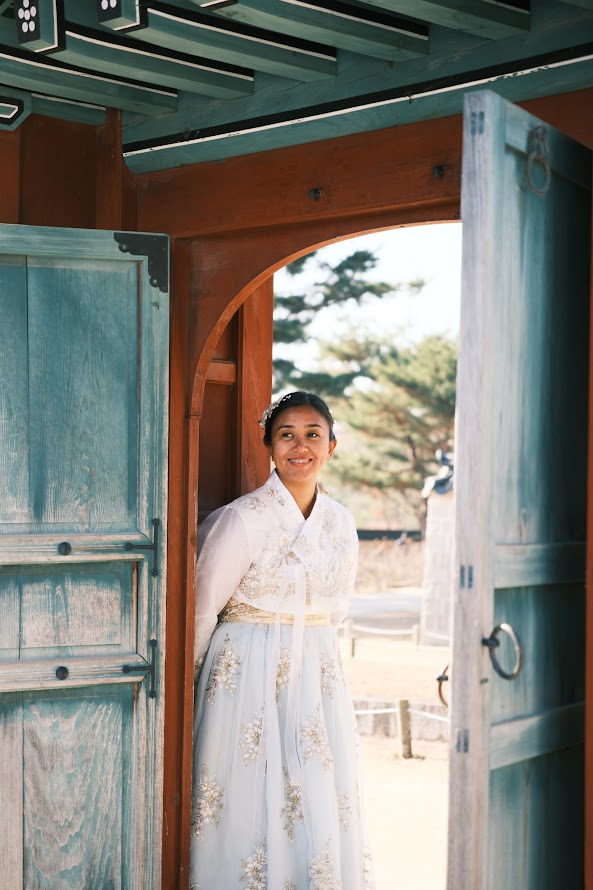
I arrived early for my photoshoot at Gyeongbokgung Palace today with Sean, my photographer. I actually found him while researching on Instagram. But first, I needed to rent a hanbok so I can enter the palace for free and it will add magic to my photos later.
GigiBebe Hanbok Studio
The shop, located near the palace, offers hanbok rentals. I rented a hanbok for 20k KRW for 2 hours, a white coat for 5k KRW, and a hairstyle for 3k KRW. I decided not to go for makeup, as they mentioned it would be quite expensive. Keep in mind that if you exceed the 2-hour rental period, there’s an additional 5k KRW charge, which I ended up paying. There are several shops around the palace, so you can explore and choose the one that suits you best. For this shoot, I opted for a princess dress. I have become gongju-mama for a day.
Please note: You’ll be given a locker to store your belongings while you explore the area. However, the key must be left with them, so remember to carry any essential items with you.
Sorry Sorry Espresso Bar
Since I was still early, I decided to grab a shakerato for 4k KRW and an egg tart for 3k KRW at a café across from the hanbok studio. I relaxed there for another hour before heading to the palace.

Gyeongbokgung Palace
November-February 09:00-17:00 (Last admission 16:00)
March-May & September-October 09:00-18:00 (Last admission 17:00)
June-August 09:00-18:30 (Last admission 17:30)
Close Tuesdays (Open in the case of Tuesday being a public holiday)
Free for those wearing hanbok but 3k KRW if you are not wearing hanbok
Gyeongbokgung Palace, built in 1395 by King Taejo, the founder of the Joseon dynasty, served as the official royal residence. Many kings were crowned here. The palace was destroyed by fire during the Imjin War (1592-1598) but was later restored under Heungseondaewongun during King Gojong’s reign. However, after the assassination of Empress Myeongseong, it lost its role as a royal palace, marking the decline of the Joseon dynasty. More info here
The palace was massive as I explored it but was very beautiful while wearing my hanbok, I didn’t know that walking will be hard though, it’s hard to be a princess during Joseon dynasty haha!
Things to Note:
1.The Public Guard Training happens at 9:35 AM and 1:35 PM.
2. There is a free guided tour at the palace where you can learn more about its history and Korea. The tours start in front of the Gyeongbokgung Palace Information Center at Heungnyemun Gate (1 to 1.5 hours). No reservation is required. English tours are available at 11:00 AM, 1:30 PM, and 3:30 PM (Wednesday to Monday). I didn’t take the tour this time, but I plan to do so next visit.
3. The Palace Guard Changing Ceremony takes place at 10:00 AM and 2:00 PM (I was able to witness this, and it was really cool!).
4. the Guard Dispatch Ceremony is at 11:00 AM and 1:00 PM.
I met Sean at 11:30 AM and had a wonderful photoshoot with him. He was very friendly, and I learned a lot, especially about how to pose. I’m so glad I booked him for this shoot, as he shared interesting insights about Korea. You can follow him or book a session through his Instagram page here.


National Palace Museum of Korea
Open daily 10:00 – 18:00
The National Palace Museum of Korea is a dedicated institution for preserving and researching artifacts from the Joseon royal and Korean imperial courts. It opened on August 15, 2005, to mark the 60th anniversary of Korea’s independence. After undergoing renovations, the museum reopened its three-story building and all its galleries on November 28, 2007.
When I visited, I was pleasantly surprised by the delightful fragrance in the museum – it was the nicest smell I’ve ever encountered in a museum. During my visit, there was an exhibit called “Joseon’s Royal Cuisine: A Table for Food, Reverence, and Sharing,” which runs from November 20 to February 2. I had the chance to explore the dishes served in the royal palace, and the overall experience was fantastic! I’ll definitely return and plan to visit all the museums in South Korea.
Tosokchon Samgyetang
10:00-22:00 (open all year round)
After changing and returning the hanbok to the shop, I headed for lunch near the palace.
Samgyetang is a traditional Korean dish known for its nutritional benefits, made by simmering a young chicken with ginseng, jujube, sweet rice batter, and various nuts. Tosokchon Samgyetang is a highly popular restaurant renowned for its ginseng chicken soup. It has only one main branch, which is quite spacious, offering over 400 seating options.
I tried insamju (ginseng liquor) served alongside my samgyetang. The insamju was quite strong and not exactly the type of liquor I was expecting, but it was interesting to try. As for the samgyetang, it’s like a chicken porridge, but here they use a small chicken stuffed with rice, ginseng, garlic, and jujube. The chicken is tender and flavorful. It’s a popular dish in Korea during the summer. While I enjoyed trying it, it’s not my go-to Korean dish.
Bukchon Hanok Village
Weekdays & Saturdays 10:00-17:00
Closed on Sundays
Bukchon Hanok Village, located between Gyeongbokgung Palace, Changdeokgung Palace, and Jongmyo Shrine, is home to hundreds of traditional hanok houses from the Joseon dynasty. The name “Bukchon” means “northern village” as it lies north of Cheonggyecheon Stream and Jongno. Today, many hanoks serve as cultural centers, guesthouses, restaurants, and tea houses, offering visitors a chance to experience traditional Korean culture. As it’s also a residential area, visitors are encouraged to be respectful while exploring.
I made a quick stop here to check.
Seoul Moonlight Walking Tour With Local Historian via Airbnb experience
I met Jessica our tour guide for this tour in Hyewha station. Together with another 3 guests we explored the following places Ehwa mural village, Maronie park, Seoul national university, Naksan park, and Hanyang city wall. This is somewhat walking tour and really appreciate how this experience brought me so much insights about the history and culture of South Korea.
We first stopped at Seoul National University (SNU), one of the most prestigious universities in South Korea. The College Scholastic Ability Test (CSAT), or Suneung, is a critical standardized exam held once a year on the third Thursday in November. Education holds immense value in South Korean society, and students dedicate years of hard work to prepare for this test. During the listening section of the exam, air traffic is grounded, and no flights are allowed in or out of South Korea to avoid any disruptions. Additionally, many stores and banks open an hour later on this day to accommodate students traveling to their exam centers. For those running late, the police can be called to assist in getting to the testing location on time.
The CSAT plays a pivotal role in determining a student’s future, as it is the primary factor for university admission. The top three universities in South Korea—Seoul National University, Korea University, and Yonsei University—are collectively known as SKY, and admission to one of these schools is seen as a pathway to high-status jobs and opportunities. If a student does not perform well, they can retake the exam the following year, but the results remain a crucial element in shaping their future academic and career prospects.
Daehangno, Marronnier Park
Hyehwa-dong was once the heart of Seoul’s art and music scene, and although it has evolved, it remains an important hub for the arts. Daehangno, located here, is home to Seoul’s largest theatre district, with over 150 small theatres. It’s often the training ground for many of South Korea’s most popular K-drama actors. Despite its busy nature, the area also features an outdoor stage for performances.
From the park, we walked to the Ihwa Mural Village, a former residential area revitalized through art. In the village, you can rent old school uniforms and wander through the narrow, nostalgic alleys. Thanks to its popularity, the village now has several cafes. The mural village is also linked to Naksan Park. Due to complaints from locals about the crowds, the famous murals on the stairs were removed, and fewer tourists visit the area now. However, I still think it remains one of the best places to visit in Seoul.
Naksan Park
Naksan Park is named for its shape, which resembles a camel’s back. It is also part of the Seoul city fortress wall, a structure built during the Joseon Dynasty to protect the city. From Naksan Mountain, you can enjoy stunning views of Seoul, stretching all the way to Namsan Tower, another landmark along the fortress wall. Naksan Park is particularly renowned for offering some of the best sunset views in the city.
Things to Note:
1. Ihwa Mural Village is often called “daldongne” or “moon village” due to its hillside location, meaning you’ll need to prepare for a bit of a hike to explore the village and take in the beautiful views of Seoul.
2. The statue in Hyehwa features a dog and a worker, symbolizing a significant moment in the district’s history. The dog stands for loyalty and companionship, while the worker reflects the area’s artistic, cultural, and working-class heritage. This statue honors Hyehwa’s transformation and its cultural significance in Seoul.
3. The tour lasts between 1.5 to 2 hours, and participants are provided with headsets to hear the guide’s commentary throughout the experience.
4. Airbnb experience here
5. Video here
I had an amazing time on this history tour and learned so much about South Korea’s rich history and culture. This was one of the highlights of my South Korea trip. I would love to have similar experiences whenever I travel abroad in the future. It’s definitely a must-do!
Korean bbq place (I forgot the name but it’s walking distance in Janghanpyeong station)
Airbnb experience here
After the tour, I joined another Airbnb experience to dine with locals and try different cuts of pork in a Korean BBQ setting. I met Ashley, a Filipino who was also part of the tour, and our guide, Jin. With just four of us, including Jin, it made for a very intimate and enjoyable experience. I love how personal Airbnb tours can be. It was also during this experience that I learned from the strangers I met that I could use Uber to book a taxi. I ended up using it right after!
I was thrilled to try somaek, a popular Korean cocktail made by mixing soju, a traditional rice spirit, with beer. To make it foamy, you strike the bottom of the glass with a fork or chopsticks. I asked Jin to make one for us, and it was so much fun! I also learned that Koreans use “jjan” instead of “gombae” when clinking glasses. I had a fantastic time, met new people, and will definitely be doing this again in the future!
Aquafield Hanam
December 17 (Tuesday)
Day12
After arriving at Gimpo Domestic Airport from my trip to Jeju, I still had some time to spare, so I decided to try a jjimjilbang (Korean spa) located 45 minutes away from the airport. This traditional Korean spa experience was something I wanted to try closer to Seoul. While I was happy with the experience, I still preferred the jjimjilbang in Busan. The one in Busan was much larger, offering a variety of spas to choose from, and the massage area was also more spacious, which made it a better experience overall for me.
Aquafield is located on the 4th floor of Starfield Mall. Fortunately, I was able to leave my luggage at the reception, where they also offered a discount for the late afternoon (around 3 pm KST), so I only paid 13,000 KRW. After paying, I received a receipt with my locker number. I handed my luggage to the concierge, then proceeded to place my shoes in a locker, collected my spa clothes at another counter, and stored my remaining items in a locker in the female dressing area. Please note that no videos are allowed in the women’s changing area.
The spa area includes showers and hot baths, and after changing into my spa attire, I explored the jjimjilbang and tried all the different spa rooms. It was incredibly relaxing. Afterward, I enjoyed a snack from their snack bar and relaxed in the rest area, where I could even watch TV. I particularly enjoyed the sikhye (sweet rice punch), which was flavorful and soothing—a treat I’d only seen in K-dramas until now.
After two hours of relaxation, I returned to the changing room, showered, and took a plunge in the hot bath before finishing with the steam room. They also have a powder room where you can dry your hair and freshen up after your shower. I had a perfect last day at this jjimjilbang.
If you can’t make it to Busan for a jjimjilbang experience, this is a great alternative. The spa rooms, such as the cloud room, bulgama, charcoal, and salt rooms, are similar to those in Busan—except for the cloud room, where I almost fell asleep! Just like Busan’s Aquafield, this one is also owned by Shinsegae. More info here
*More info about jjimjilbang experience when I write about Busan trip.
to be continued on the part 2 of my trip
Love,
Maria, sometimes, Niskie
Leave a Reply