Day 14 – May 27: Arizona | Utah border | Page, AZ | Grand Canyon Village
Morning: McDonald’s and the State Line
We started the day with breakfast at McDonald’s. One of my favourite things about eating at McDonald’s in the US is the free refill on drinks — soda and juice, that is. (Just a heads-up: coffee does not get a refill, so savour that cup!) I went with the classic American breakfast: pancakes, biscuits, and scrambled eggs. Simple, filling, and exactly what we needed for a big day ahead.
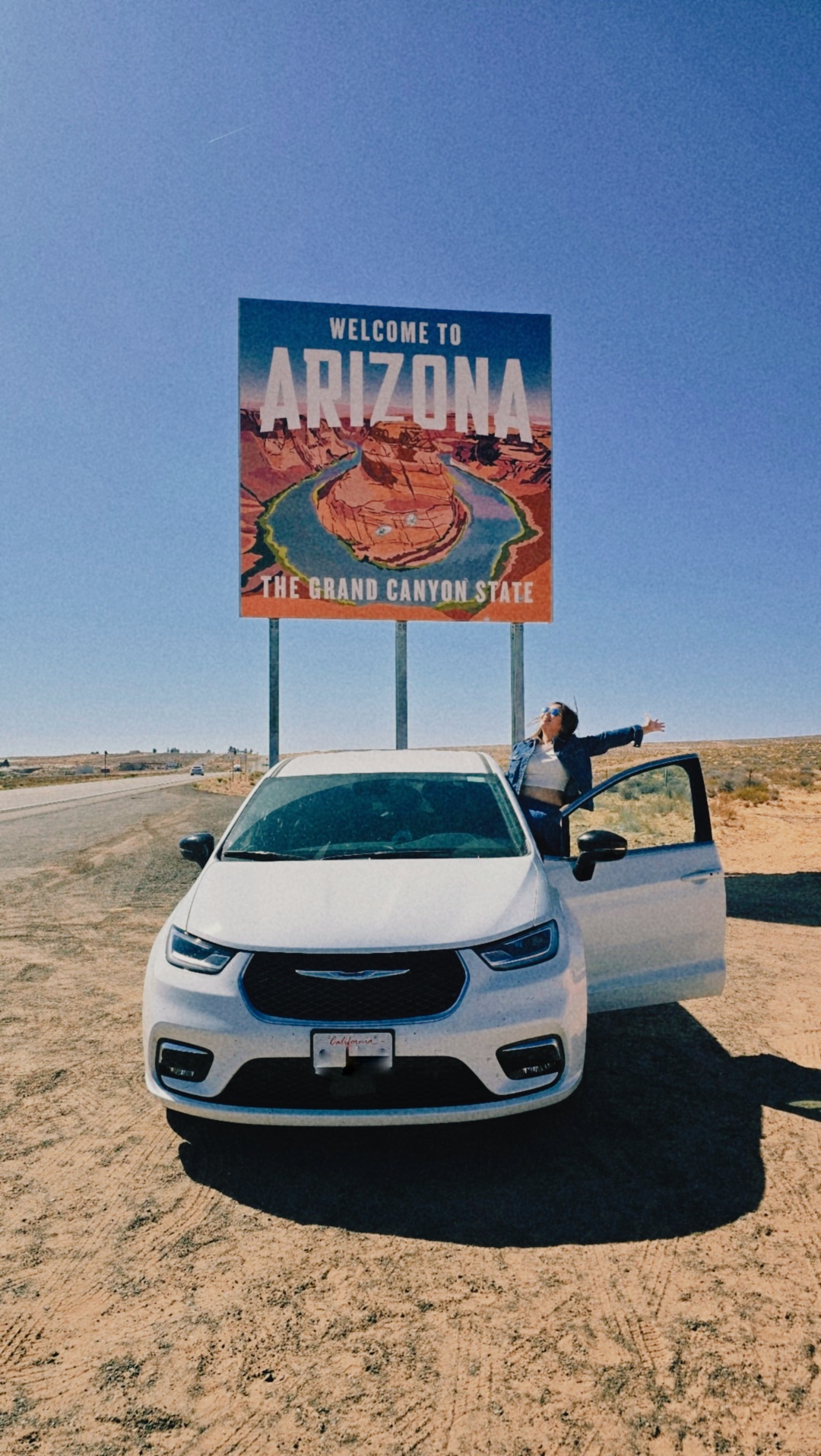
After breakfast, we hit the road and within minutes came across two iconic roadside signs back to back: first the Welcome to Utah sign, and then just a few minutes later, the Welcome to Arizona sign. They really are that close to each other, which made for some fun photo stops.


One funny thing worth mentioning: because Utah and Arizona sit so close together at this particular stretch, our phones had a hard time locking onto the correct timezone. Arizona (outside of the Navajo Nation) does not observe Daylight Saving Time, while Utah does — so crossing back and forth through that narrow corridor had our phones glitching between time zones. It was a little confusing, but it’s part of the adventure!
Wahweap Viewpoint & Glen Canyon Overlook
Our first proper stop of the day was the Wahweap Viewpoint, which overlooks the shimmering waters of Lake Powell and the dramatic red rock landscape of the Glen Canyon area. It was already getting warm when we arrived, a sign of what the rest of the day had in store.
From there, we hiked a short distance to the Glen Canyon Overlook. We thought the main path would give us the best view, but it turned out we needed to trek a bit further to reach the actual overlook. It was worth it, the sweeping canyon vistas were stunning — though we had to keep moving because we had a timed reservation at our next stop.


Lower Antelope Canyon — Ken’s Tours
Price: USD 73 / approximately PHP 4,445 per person
This was one of the stops I was most excited about, and it did not disappoint.
Reservations are essential for Lower Antelope Canyon, and they sell out fast — even on weekdays. Tours are operated exclusively by Navajo-owned companies because the land belongs to the Navajo Nation. We were lucky to have secured our spot in advance.
A Sacred Place
Lower Antelope Canyon is known to the Navajo people as Hasdeztwazi, meaning “spiral rock arches.” It is one of several slot canyon sections within the Lake Powell Navajo Tribal Park, located near Page, Arizona. The canyon was formed over millions of years by flash flooding that carved through Navajo Sandstone — the same reddish rock you see across the American Southwest. The walls are smooth and flowing, shaped like waves frozen in stone, and the colours shift from deep burgundy to burnt orange to gold depending on the light.
The Navajo consider Antelope Canyon a deeply sacred site — a place where the physical and spiritual worlds intersect.
Entering the canyon is, for them, akin to entering a cathedral. Our guide shared that in Navajo oral tradition, the canyon served as a place of refuge and sanctuary during times of conflict, offering shelter and protection to their people.
The Navajo Nation officially designated Antelope Canyon as a Tribal Park in 1997. All visits must be conducted with an authorised Navajo guide — no exceptions.
The Tour Experience
There is a souvenir shop and restroom facilities near the entrance, and our guide gave us a brief introduction before leading us into the canyon.
A few important rules were explained before we descended:
1. No videography is permitted inside Lower Antelope Canyon. The canyon and its imagery are considered cultural property of the Navajo Nation, and commercial exploitation of video content is not allowed.
2. No scratching or touching the sandstone walls.
3. There are stairs as you descend into the canyon — wear appropriate footwear. (I wore a skirt with shorts underneath was not ideal attire for the climb.)
The tour itself lasted about 45 minutes, which honestly felt too short. The guide moved us along at a brisk pace because other tour groups were following behind us. It’s the one downside of the experience — you have to be quick with your photos.
Fun Fact: The Windtalkers Connection
Speaking of the Navajo people — have you seen the 2002 war film Windtalkers, starring Nicolas Cage? The film is based on the remarkable true story of the Navajo Code Talkers — Navajo men recruited by the U.S. Marine Corps during World War II to transmit military communications in a code based on the Navajo language. Because Navajo is an unwritten language with extremely complex syntax and tonal qualities, the Japanese were never able to crack the code. It is widely credited as one of the key advantages that helped the Allies secure victory in the Pacific.
In Windtalkers, Nicolas Cage plays Sergeant Joe Enders, a Marine assigned to protect a Navajo code talker named Ben Yahzee (played by Adam Beach). While the film centres its story on Cage’s character rather than the Navajo men themselves — a criticism many reviewers raised — it did help bring the story of the Code Talkers to wider public awareness. The real code talkers were some of the most remarkable and unsung heroes of World War II.
A Living Screensaver
I kept thinking that Lower Antelope Canyon looks exactly like those beautiful desktop wallpapers you see on computers — the kind that make you stop and stare. And it turns out that Antelope Canyon imagery has indeed been widely used as computer wallpaper and screensavers over the years, so much so that it has become synonymous with that “screensaver canyon” look. It truly is that beautiful in person.
Despite what many people assume, Lower Antelope Canyon is not the Grand Canyon — they are entirely separate locations with their own distinct geological histories and cultural significance. Lower Antelope Canyon is a slot canyon; the Grand Canyon is a massive open gorge carved by the Colorado River. Two very different (and equally spectacular) wonders.


Horseshoe Bend
After the canyon, we made our way to Horseshoe Bend, one of the most photographed natural landmarks in Arizona.
What Is Horseshoe Bend?
Horseshoe Bend is a dramatic meander of the Colorado River, located near Page, Arizona, within Glen Canyon National Recreation Area. It gets its name from the river’s striking 270-degree horseshoe-shaped curve around a massive sandstone escarpment — when you see it from the overlook, you understand the name immediately.
The bend was formed approximately five to six million years ago when tectonic uplift of the Colorado Plateau caused the river to carve deeply downward into the sandstone rather than continue meandering across a flat plain. The result is a canyon roughly 1,000 feet deep, with the turquoise waters of the Colorado River winding around the base far below.
Though many visitors associate it with the Grand Canyon, Horseshoe Bend is actually part of Glen Canyon National Recreation Area — the Grand Canyon National Park begins several miles downstream.
The Hike to the Overlook
To reach the viewpoint, you walk a 1.5-mile (approximately 2.4 km) round-trip trail from the parking area. The path is paved and relatively flat, but the desert heat and wind — combined with sand blowing across the trail — make it feel like more of an effort than it looks on paper. We were all feeling the heat by the time we reached the edge.
It is absolutely worth it. The view is breathtaking. The sheer scale of it — the river a thousand feet below, the red canyon walls curving in that perfect horseshoe — is the kind of sight that makes you go quiet.
A word of caution: be very careful near the rim. The drop is sheer and the sandstone can be slippery, especially in the wind. Keep a firm footing and stay back from the edge when taking photos.
There are also a few rest stops along the trail for those who need a breather — a welcome feature on a hot day!
One small dramatic moment on our visit: someone in our group had a minor tumble on the path and lost a tooth in the fall. Thankfully, no one was seriously hurt, and after a moment of shock (and sympathy!), we carried on.

Desert View Watchtower — First Glimpse of the Grand Canyon
On our drive into Grand Canyon Village, we pulled over at the Desert View Parking Lot and spotted an elk grazing calmly just off the road. Elk are large members of the deer family — the males carry enormous branching antlers that can span over a metre — and seeing one in the wild like that, completely unbothered by us, was such a gift.
I could have watched it walk peacefully through the landscape for hours.
We then stopped at the Desert View Watchtower, a 70-foot stone tower built in 1932 by architect Mary Colter, who designed it to evoke the ancient Ancestral Puebloan towers of the Colorado Plateau. Inside, the walls are decorated with murals by Hopi artist Fred Kabotie depicting Hopi history and traditions. The tower is an Inter-Tribal Cultural Heritage Site and hosts cultural programmes and demonstrations by indigenous artists.
Unfortunately, the upper floors of the tower were closed when we visited, so we were unable to climb to the observation deck. But the views from the rim itself — looking out over the eastern expanse of the Grand Canyon as the sun began to lower — were spectacular. The canyon glowed in deep reds and purples as dusk approached.
There is also a Starbucks at Desert View, which came as a very welcome surprise after a long hot day. There is also a trading post, a general store, and restrooms.
One thing we noticed immediately: the temperature had dropped significantly from Horseshoe Bend. The elevation at Desert View is around 7,400 feet above sea level, and the air was noticeably cooler — at least five degrees Celsius colder than it had been earlier. Pack a layer if you are visiting in the late afternoon!


Grand Canyon Hotel & Suites, Tusayan — Our Base for the Night
Hotel rate: USD 245 / approximately PHP 15,000 per night
We stayed at the Grand Canyon Hotel & Suites, located in Tusayan — a small gateway town just one mile south of the Grand Canyon National Park entrance. It is worth knowing that Tusayan and Grand Canyon Village are two different places: Grand Canyon Village is the historic community inside the park right on the South Rim, while Tusayan sits just outside the park gates. That said, the two are only a short drive apart, making Tusayan a very convenient base.
Tusayan has its own cluster of hotels, restaurants, and shops — and it is also home to the IMAX Theatre (operated by the Grand Canyon Visitor Center) where you can watch a film about the canyon’s history before or after your visit. It is ticketed and runs showings throughout the day — well worth it if you want some context before stepping into the park.
Our hotel was spacious and very comfortable — it had an elevator, two double beds, a full bathroom with a bathtub, free breakfast, and parking. After the heat and the miles we covered that day, sinking into that room felt like a reward.
In the evening, we strolled into the village to find dinner. Most places were wrapping up for the night, but we found a Pizza Hut still open. We ordered pizza, pasta, and a corn dog (my pick), along with Pepsi — with refills, naturally. The restaurant was closing around 8:30 PM, so all orders were takeaway. We ate outside the store, which was actually a lovely way to end the day — sitting in the cool evening air, full of food, with the Grand Canyon just around the corner waiting for us tomorrow.
We headed back to the hotel and got some rest. The next day, the main event: the Grand Canyon itself.


Next up — Day 15: Exploring the Grand Canyon 🏜️
Leave a Reply