Tired of crowded beaches? Discover Balabac, Palawan’s hidden paradise, where untouched islands, crystal waters, and secret lagoons await your next adventure.
Disclaimer: All views expressed on this blog are my own based on my own experiences and do not represent of any entity with which I have been, are now or will be affiliated
September 08, 2025
Date of Trip: August 25-September 01
PPS: August 29-September 01
This marks the next chapter of my Palawan adventures — from Coron to Puerto Princesa, and now, Balabac. I’ve fallen in love with Palawan, and not once during my stays here did I feel a dull moment. My goal is to explore as many of its breathtaking islands as I can and share their beauty with you.
Balabac has been on my radar for a while. Every time I travel locally, I meet fellow adventurers who can’t stop talking about it, the crystal-clear waters, the remote island vibe, and that impossibly fine white sand you could almost mistake for powder. After my amazing trip to Puerto Princesa last week, I found myself craving another dose of adventure.
Balabac is often described as Palawan’s hidden paradise, tucked away in the southernmost tip of the province. It’s not the easiest place to reach, but maybe that’s what keeps it so raw and untouched. They say here you’ll find some of the most beautiful sandbars in the Philippines, vibrant marine life, and sunsets that make you forget time.
So, with all that in mind, I booked my flight back to Puerto Princesa, this time with one goal in mind: to finally experience Balabac’s magic for myself.
PS: I intentionally booked this trip right after the long weekend in the Philippines. August 25th was National Heroes Day, and traveling during holidays anywhere in the country usually means double the crowd, which can take away from the overall experience.
How to go to Balabac from Manila?
There’s no direct flight from Manila to Balabac — you’ll need to fly to Puerto Princesa first. DIY trips aren’t really an option here, so you’ll have to coordinate with local tour organizers to explore the island. For this trip, I booked my Manila–Puerto Princesa flight with Cebu Pacific for PHP 2,964.22, and my return with AirAsia for PHP 2,640.96, plus PHP 482 for extra carry-on. (Heads up: they do weigh your carry-on at departure, even if you’re using an e-boarding pass.)


Currency/ATMs – PHP. Most ATMs are located within Puerto Princesa proper. It’s best to withdraw cash at the airport before heading out, as there are no ATMs on the island.
Internet Connection – Please note that the base camp we stayed at on Canibungan Island has no reliable mobile coverage or Wi-Fi. On Onuk Island (the most popular island in Balabac), there’s Wi-Fi that works fairly well but only in a specific spot, and Smart offers LTE service, though the signal can be inconsistent.
Weather – Balabac has a tropical climate with two main seasons: the dry season from January to June, and the wet season from July to December. August falls within the Philippines’ typhoon season (June to October). During our trip, a low-pressure area in Pangasinan, combined with the southwest monsoon affecting Luzon, Visayas, and Mindanao, left us stranded on Onuk Island for 4 days and 3 nights.
Language – Tagalog and English can be understood by some residents.
Transportation – When I landed at Puerto Princesa International Airport, I waited outside for the transfer van arranged by my tour organizer, which was included in my package. I was picked up at around 2:30 AM, and the journey from Puerto Princesa to Buliluyan port took roughly 6 hours, covering about 280 km.
After arriving at Buliluyan Port, we waited about an hour post-registration for our speedboat pickup. I’d heard it would take around 2 hours to reach the island, but to my surprise, the ride was smooth and only took about 45–50 minutes to get to our base camp in Canibungan.
Where Did I Book This Trip?
I booked my trip with Travan Travel & Tours, which I found on Facebook, for PHP 14,000. The package included an overnight stay in Onuk, full board meals, a tour guide, island fees, and accommodations. “Basic” accommodation means sleeping in a tent with a bed, pillow, and blanket but no fan, while in Onuk, there’s a stilt house available for lodging.
Things to Note:
1. At first, I thought this trip was being handled solely by the organizer I booked with. But upon arrival, I learned that we were actually turned over to a local operator in Balabac — Balabac Lakbay Isla by Kuya Aying. It turns out that many outside organizers coordinate with this same local group, and all guests are managed under them. My tip? Contact Balabac Lakbay Isla by Kuya Aying directly for smoother communication. Here’s their FB page link
2. This is a true adventure-style island trip. Expect little to no internet connection most of the time, nights spent in a tent (which can be uncomfortable if you’ve never tried it — though I’ve camped on a mountain before, and that was even rougher without a bed 😅), and the presence of mosquitoes. Weather can also cause delays, so you might end up stranded.
3. This is not a luxury getaway — if you’re not comfortable showering in public with your shirt on, this trip might not be for you. Water supply on the campsite can run out since they rely mainly on collected rainwater.
4. There’s only one store on the island, and thankfully, they don’t overprice. However, when we were stuck in Onuk, there was no mineral water available, which could be a problem if you have a sensitive stomach.
5. There’s no regular electricity on the island. A generator runs at night but is turned off at 5am, and outlets are limited so be sure to bring a power bank.
6. We got stranded in Onuk for 4 days, which meant skipping the next day’s island activity. So, our 5-day, 4-night island stay turned into what felt like an extended “Onuk vacation” – four full days of nothing but that stunning view. Honestly, not a bad place to be stuck!
6. Patience has been essential in all my adventures. I love exploring, and this trip is yet another reminder of why traveling around the Philippines is so special to me.
Things to Bring:
1.Mosquito repellent
2.Sunscreen
3.Pocket Money
4.Powerbank
5.Extension wire (I’ve seen people bring this on my Zambasulta trip, and it can be useful at times. But if you think it’s too bulky, it’s fine to skip it during our tent stay, they used an extension cord so we could still charge our phones.)
6.Portable fan (There are no fans in the tents. I personally didn’t find it to be much of an issue, but if you’re someone who struggles to sleep in the heat, it’s best to bring your own portable fan.
7. Extra snacks and mineral water
Day 1 — August 25 (Monday)
NAIA Terminal 3 → Puerto Princesa International Airport
Itinerary:
Buliluyan Port
Tangkahan Island
Patawan Island
Canibungan Island
I had a morning flight to Puerto Princesa, so I left Batangas the night before to make it in time. Thankfully, Cebu Pacific, my airline for this trip, has self-service kiosks where you can easily print your boarding pass. You can also do this online, but for domestic flights, the kiosks make it convenient as well. I’m not sure if this works for international flights now (it didn’t before), but I might give it a try next time I travel abroad.
The flight left on time, and I had already coordinated with my shared van transfer driver before we landed. He told me to leave the airport and wait by the highway since they weren’t allowed to pick up passengers inside the airport vicinity. Honestly, I doubt that’s the real reason — it’s probably just more convenient for them to meet on the main road. Either way, it was just a short walk to the highway, where I waited with the guards.
I was picked up around 3 AM, and the driver went on to collect other passengers. I noticed everyone had brought snacks, while I had none, I thought they’d just be bulky to carry. The van can be cramped, so I made sure to choose a seat where I could stretch my legs. Pro tip: bring a small blanket and a cap, because it gets really cold inside.
After about 1.5 hours, we had a quick stop for food, then I slept for the rest of the ride, something I always end up doing on tours like this. We arrived at Buliluyan Port at around 7:50 AM, almost 5 hours later, including the stopover.
Buliluyan Port
The port wasn’t crowded with tourists, and there were a few small stores selling basic necessities like food and drinks. They even had a paid piso Wi-Fi service, handy if you need to connect since there’s no regular internet signal here. There’s also a clean toilet available, but take note, it’s PHP 5 per use.
Our local organizers from Balabac Lakbay Isla approached us, had us register our names, and told us we’d be waiting about an hour for the speedboat to arrive.
Tangkahan Island
Our first stop was Tangkahan Island, about a 35-minute ride from the port, where we were scheduled to have lunch. The island was stunning: soft, powdery white sand, crystal-clear waters, and such a peaceful vibe. While waiting for lunch, I went for a swim and even met a friendly group of travelers who welcomed me to join them for the rest of the trip.
Lunch was incredible — fresh, meaty crabs (Palawan seafood is unmatched!) and sweet pineapple for dessert. If you’re a fruit lover, you’ll definitely be happy here.


Patawan Island
Just 15–20 minutes from Tangkahan lies Patawan Island, a small, jewel-like paradise shaped like a dolphin. Known for its powdery white sand, it’s quickly gaining popularity. The island offers accommodations, a private beach area, a terrace, and even a bar.
I instantly loved the vibe here especially the fact that they have a bar. I usually look for a fruit shake when I’m on an island, but while they didn’t have one, they did have iced Americano, which was a nice alternative. Drinks range from PHP 200–400, which isn’t too bad compared to prices on other Philippine islands.
If you want to stay overnight, they offer tent accommodations for about PHP 6,000 per night (according to Booking.com). You can also check booking apps for updated rates and availability.


Canibungan Island
Just a short 10–15 minute boat ride from Patawan Island lies Canibungan Island, where our base camp was located. This scenic gem features a stunning stretch of white-sand beach, often framed by sloping pine trees.
I really enjoyed swimming at the beach here, it was so refreshing. At night, they even have a free fire dance show (donations are welcome), which adds to the island vibe. There’s also a small store, and I appreciate that they don’t overprice their goods. The only downsides are the low water supply in the toilets and the abundance of mosquitoes, so definitely pack mosquito repellent. Still, it didn’t take away from the experience. I’m just excited to finally head to Onuk tomorrow!


Day 2 — August 26 (Tuesday)
Onuk Island
Just 40 minutes from Canibungan Island lies Onuk Island. I packed for what was supposed to be a one-night stay — or so we thought! Haha
This was the part I was most excited about! Everyone I’ve met kept raving about Onuk—calling it the best island in the Philippines with unbelievably fine white sand. I knew I had to see it for myself. It’s been long overdue, but I finally set foot in Balabac and Onuk Island.
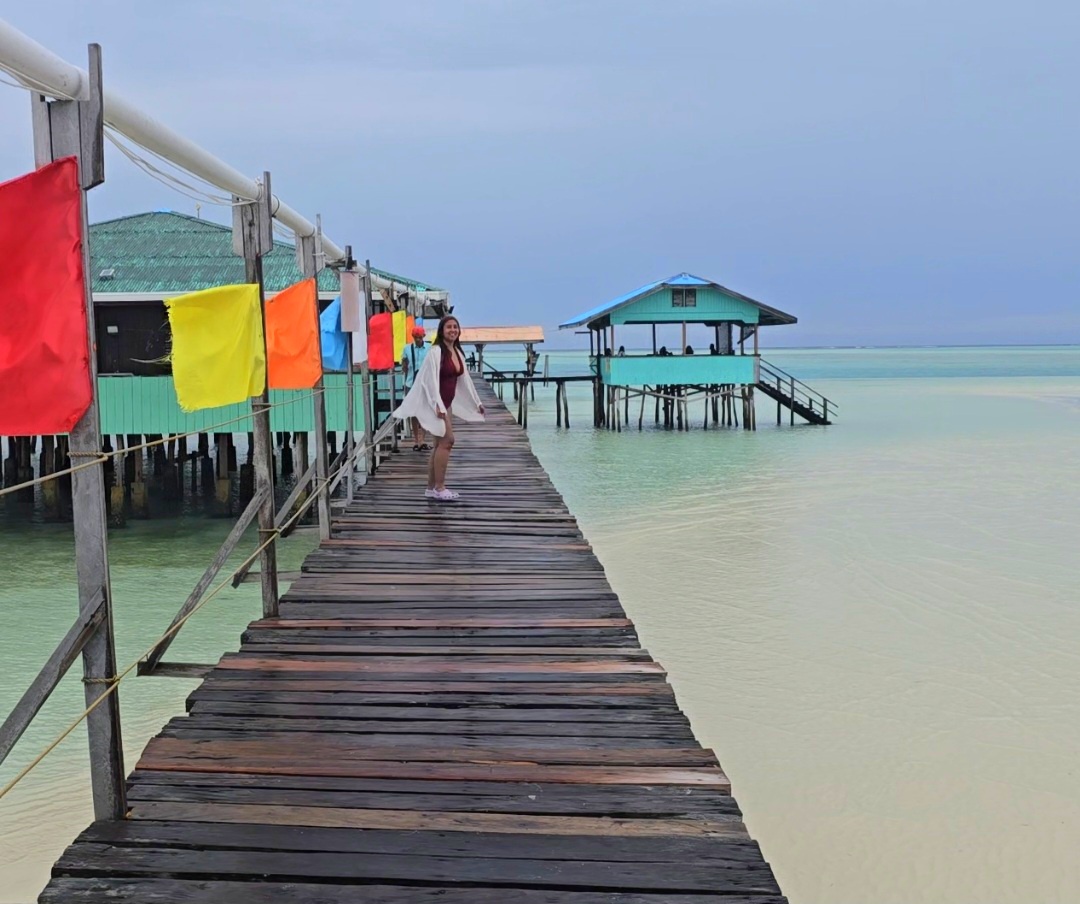
Onuk Island is a small slice of paradise in southern Palawan, known for its expansive crystal-clear shallow waters, vibrant giant clams, and a breathtaking sandbar that emerges during low tide. It’s also home to wild sea turtles, a thriving coral reef, and a charming stilt walkway over the water — making it a true tropical gem worth the journey. Standing there, with nothing but the sound of the waves and the endless blue horizon, you can’t help but feel like you’ve stepped into a dream.
The moment I set foot on Onuk Island, I was instantly amazed and greeted by sea turtles casually swimming around, completely unbothered by our presence. I’ve encountered sea turtles before in Apo Island, Dumaguete where you can actually swim alongside them and nothing beats that magical first-time experience. That’s the kind of magic Apo Island holds for me. Still, seeing them here in Onuk was a wonderful experience in its own right.
Before lunch, I couldn’t resist diving into the clear waters and swimming over the white sandbar. By 6:00 PM, low tide had set in, revealing even more of its beauty, the kind of scenery no photo could ever truly capture.
I was lucky enough to be invited by the group of friends I’d met earlier to share their room, since I was the only solo traveler. We stayed in one of the stilt houses, which was such a unique experience. The only downside? The nearby toilet wasn’t the best, but there were cleaner ones about a five-minute walk away, so it wasn’t a big deal.
There was a slight hiccup with the overnight arrangements — a misunderstanding that led to some heated discussions. We thought our package didn’t include the overnight stay, but it turned out it did. There was supposed to be an additional ₱1,000 fee for tents on the nearby island, but those spots were given to someone else rather than on a first-come, first-served basis. In the end, our stilt house worked out fine.
The shower facilities were also a five-minute walk away. There were only two private shower areas, and one was locked, so I had to shower in a more open area which honestly wasn’t a big problem for me. My only frustration was that for ₱1,000 per night, the facilities and service could have been better.
Still, I loved the exclusivity of Onuk. There were only two groups on the island, and with it being low season, it felt like our own private paradise. I could easily stay here for days… and as fate would have it, I actually did. Haha!


Day 3 — August 27 (Wednesday)
Onuk Island
I could easily stay here for days… and as fate would have it, I actually did. Haha!
Over breakfast, the news came: No boats today. Strong winds, rough seas. The island-hopping we planned? Cancelled. I laughed it off — “Okay, bonus beach day!” We spent the day swimming, chatting, and basically doing nothing productive. I also took the chance to do some laundry since I had only packed for a one-night stay on the island.


Day 4 — August 28 (Thursday)
Onuk Island
I’ll be honest, there was a moment I just wanted to go home. My flight was scheduled for early the next morning, and the thought of being stuck yet another day felt exhausting. Supplies were already running low; mineral water had run out, and we had to rely on the island’s water supply. Thankfully, I was lucky enough to avoid any stomach issues.
Then, after breakfast, came the news: departure postponed again due to strong southwest monsoon winds. At that point, my phone had basically become just a camera. The signal was intermittent, but there was a small Wi-Fi spot in the stilt house — though not strong enough for mindless scrolling. We rationed what was left of the water, used rainwater for washing, and settled into the rhythm of island life.
I’d already bonded with my group by then. We shared stories, laughed over the smallest things, and fell into a simple daily cycle: wake up, stare at the horizon, eat seafood, nap, swim, repeat. I even started naming the sea turtles like they were my neighbors. And yes I found the so-called “strongest” Wi-Fi spot.
This time, AirAsia emailed me about my rescheduled flight for Friday, August 29. I decided to move it to September 1, figuring there was a good chance I’d be stranded again the next day — and also hoping to explore other parts of Palawan if the weather improved.


Day 5 — August 29 (Friday)
Onuk Island
Finally, the weather cleared enough for us to leave. It felt bittersweet, part of me was excited to get moving again, but another part knew I’d miss this peaceful, disconnected life.
What was supposed to be just one night in Onuk turned into four unplanned days. Strong winds and rough seas made it impossible to leave, and our island-hopping plans were scrapped. In total, we spent five days and four nights in Balabac, with four of those days entirely on Onuk.
Some might call it being stranded, but to me, it felt like the universe’s gentle reminder to pause, breathe, and be fully present. It wasn’t the adventure I had planned, but it became one I’ll never forget. This experience wasn’t on my bucket list but after Onuk, it definitely earned a spot.
Onuk set the bar so high, it made all the other islands feel ordinary in comparison. Thank you, Onuk, I’ll definitely be back.

Lessons from Being Stranded in Onuk
1. Slow travel is underrated. Sometimes, the best moments happen when you’re not rushing from one itinerary to another
2. Disconnection can be a gift. With no signal and no distractions, I had the chance to fully soak in the scenery, appreciate the silence, and connect with people face-to-face.
3.Pack for the unexpected. Extra snacks, a reusable water bottle, and a power bank can make a huge difference in remote destinations
4. Go with the flow. Travel doesn’t always go as planned — and that’s okay. Flexibility turns potential frustrations into unforgettable stories
5.Nature sets the pace. No matter how much we plan, the sea, wind, and weather will always have the final say
Finally, at 6:40 a.m., we said our goodbyes to Onuk. After a 50-minute ride, we returned to our base camp in Canibungan, relieved to find all my belongings still there—except for my forgotten swimwear! Packing took just 5–10 minutes before we headed straight back to the speedboat. The waves were wild on the way in, and we didn’t want to risk getting stranded again.
About 25–30 minutes later, we arrived at Buliluyan Port. From there, we crossed to the tourism office—right across from where the vans wait—to log our names and officially mark our departure from Balabac.
The journey back to Puerto Princesa was equally memorable. At one point, we passed through a stretch of road lined with massive trees arching overhead, creating a natural tunnel. It felt like stepping straight into a scene from Into the Woods, magical and unforgettable. You can find the video here.
Guni-Guni Hostel
I stayed at Guni-Guni Hostel in Puerto Princesa for 4 days and 3 nights, knowing I’d likely still be stuck in Onuk before heading back. I arrived around 2:30 p.m. and checked in at PHP500 per night. I booked a female dormitory with three bunk beds, its own toilet and shower, and daily cleaning—everything was spotless.
The hostel also offers transportation to Port Barton and El Nido, plus an in-house café and bar. Tours are available too, but I had already explored most of Puerto Princesa on a previous trip. Just across the street, there’s a laundromat and a bakery selling mouthwatering donuts for only PHP25.
I considered going to Port Barton, but the weather wasn’t ideal, and I didn’t want to risk being stranded again. Instead, I focused on savoring the best food spots in Puerto Princesa something I missed two weeks earlier. Some restaurants are even within walking distance.
The Café at Guni-Guni
I ordered an iced Americano, excited to finally have a proper iced drink now that I was back in civilization. Unfortunately, it was a letdown, the coffee tasted like it was made from old beans. Definitely not the satisfying treat I was craving after being stranded on an island. Haha!

SM Puerto Princesa
The hostel staff told me to skip the tricycles and just hop on a motorbike—and they were right. It’s way cheaper, plus here in Puerto Princesa, the bikes have rain covers, perfect for the random downpours. Fares are only PHP20–50, and in just 15 minutes I was at SM Puerto Princesa buying a new charging port. Good thing my old one didn’t give up on me while I was still stuck on the island!
Kalui Restaurant
💰 PHP400–1,000
🗓 Monday–Sunday
🍽 Lunch: 11:00 AM – 2:00 PM
🍽 Dinner: 6:00 PM – 10:00 PM
✅ Walk-ins welcome, but better to reserve on weekends
Just a quick 10-minute motorbike ride from the hostel, I finally tried the famous Kalui Restaurant. I arrived right when they opened for dinner at 6:00 PM, so I had the place to myself and took the chance to explore. The restaurant is spacious, spotless, and beautifully designed.
One unique thing here—you have to remove your shoes or flip-flops before entering, and they provide a cabinet to store them. While waiting for my order, I wandered around, played with their free ukuleles, and even checked out the restroom (which I loved—it’s huge, air-conditioned, and they provide sanitized flip-flops for guests).
The food? Amazing. Huge portions, fresh flavors, and worth every peso. I ordered sinigang na hipon and treated myself to a mango shake—finally! Definitely a must-visit when in Puerto Princesa.


Day 6 — August 30 (Saturday)
Puerto Princesa
Itinerary
1. Lato Coffee and Restaurant
2. NCC Supermarket
3. Haim Chicken
Lato Coffee and Restaurant
💰 Price: PHP300–500
🕒 Opens 7:00am–10:00pm Monday-Sunday
Located along the Puerto Princesa Baywalk, this cozy spot offers a relaxing view of the bay (though the current road construction kind of distracts from it). I came here for brunch and ordered their tuna sandwich and best-selling Spanish latte. The coffee was smooth, not overly sweet, and the sandwich came in a generous serving. It’s an open-air restaurant, and what makes it even cooler is that you can borrow their books while you dine.


New City Commercial Corporation (NCCC) Mall
The New City Commercial Corporation (NCCC) Malls, often simply called NCCC, are owned by the NCCC Group, a company founded and based in Davao City, Philippines. In Puerto Princesa, the local NCCC Mall is just a 10-minute drive from Guni-Guni Hostel. I dropped by to pick up a few supplies, and to my surprise, I walked right into their angelus. Everyone suddenly stopped what they were doing to pray, and right after, the staff burst into a lively 2–3 minute dance! It was such a funny and unexpected experience that I couldn’t help but enjoy it.
Haim Chicken
💰 Price Range: ₱250–₱500
🕒 Open Monday–Sunday, 9:00 AM–10:00 PM
💡 Note: Some restaurants here add a service charge.
Haim Chicken is a homegrown chicken inasal favorite in Puerto Princesa, grilling since 1999. I’m glad I finally got to try it! Just a quick 5-minute walk from my hostel, the place is spacious with both air-conditioned and al fresco seating.
Instead of the usual soy sauce dip for the chicken, they serve fish sauce — though you can request soy sauce if you prefer. The chicken was perfectly marinated, juicy, and grilled to perfection. Definitely a must-try when in Puerto Princesa!
More videos soon on my Youtube!
Day 7 — August 31 (Sunday)
Puerto Princesa
Itinerary
1.Bona’s Chao long
2.Gold Cup
Bona’s Chao Long Haus
🕒 Open Monday–Sunday, 10:00 AM–9:00 PM
💰 Price: ₱150–₱300
Chao Long holds a special place in Puerto Princesa’s history. While in Vietnam “chao long” refers to a congee made with pig innards, blood pudding, and liver, the Palaweño version — brought by Vietnamese refugees after the Fall of Saigon — is a localized take on pho. It features a sweeter, richer broth, generous meat chunks, rice noodles, and is often served with bean sprouts and calamansi.
Just a 10-minute walk from my hostel, I knew I couldn’t leave Puerto Princesa without trying it. If you skip this dish, it’s like skipping a piece of the city’s cultural story. The broth was rich with a subtle sweet tang, quite different from traditional pho, but still absolutely delicious. Highly recommended for anyone visiting Puerto Princesa.

Gold • Cup Specialty Coffee Roasters
🕒 Opening Hours: 7:00 AM – 10:00 PM
💰 Price Range: ₱300–₱500
Gold Cup has firmly established itself as a leader in Puerto Princesa’s specialty coffee scene, and their flagship store is right in the city. I walked about 20 minutes to get there, and at first I was a bit confused by the second-floor signage. A friendly guard guided me to their new space, and I instantly fell in love — it’s cozy, has an alfresco setup, and the aroma of freshly roasted coffee beans greets you as you enter.
I tried their bestseller, the Iced Barista Latte (₱295). It’s slightly on the pricier side, but the coffee packs a strong, flavorful punch, making it worth it. The café is perfect for unwinding, especially in the quiet morning hours, and there are plenty of charging ports. The staff is warm and welcoming, making it an ideal spot to relax and enjoy a great cup of coffee.

I returned to the hostel to rest and later tried a local burger spot, Vinlee’s Food Joint. The burger was just okay, but the bakery nearby, Donatos, blew me away — their donuts were unforgettable! Since it’s right across from the hostel, I’ll definitely be back next time I’m in Puerto Princesa.
I also caught up on Chainsaw Man on Netflix, as a movie release was coming soon. The hostel’s common area is perfect for this — you can eat, watch shows, and even play board games. It’s such a cozy and inviting space, making it one of my favorite places to stay in the city.

Day 8 — September 1 (Monday)
Puerto Princesa → NAIA Terminal 2 → Batangas
Finally, it was time to go home and be reunited with my dogs! I arrived at the airport early, just in time for my flight. My AirAsia flight departed and landed on schedule at NAIA Terminal 2.
I also learned that there’s a shuttle bus in the terminal, but it’s only for connecting flights — it would be great if it were free for all arriving passengers. There’s another shuttle that charges PHP50 to Terminal 3, and from there you wait for the P2P buses. I skipped this hassle and opted for Grab instead, which is by far the easiest option for travelers arriving in Manila.
I got home safely, reunited with my dogs, and finally got some well-deserved rest.
Palawan reminded me why I love traveling the Philippines so much. I came seeking a little adventure, and it gave me so much more — breathtaking islands, hidden gems, and moments I’ll never forget. Traveling our own country has shown me that we truly have some of the best beaches in Asia, and no matter the cost or challenges, I’ll never stop exploring.
Getting lost in these islands, discovering stories in my own backyard, and soaking in every view, this is the magic of the Philippines. There’s so much beauty waiting to be explored, and I can’t wait to uncover more in the months ahead.
So tell me, what’s your favorite island in the Philippines? Maybe it’s time to add it to my list!
Love,
Maria,sometimes,Niskie
Leave a Reply