Great Wall? Check. Hutongs? Check. Peking duck? Delicious. Almost watched a movie I couldn’t understand—want to know which one? Read my Beijing adventure blog!
Disclaimer: All views expressed on this blog are my own based on my own experiences and do not represent of any entity with which I have been, are now or will be affiliated.
Part 3
Date of China Trip: February 14-24
Date of Beijing Trip: February 16-19
My itinerary for my China trip includes the following: First Part Shanghai Disneyland, 2nd Part Shanghai, 3rd Part Beijing, 4th Part Xian, 5th part Leshan and 6th part Chengdu
Whenever I think of China, the Great Wall is the first thing that comes to mind. Initially, my only reason for visiting was to see this iconic landmark, but the trip turned out to be a surprisingly beautiful and unforgettable adventure.
Beijing exceeded my expectations. While Shanghai feels like a sleek, modern city reminiscent of Singapore, Beijing offers a unique blend of history and progress. It feels like stepping into old China—modern yet still carrying a rustic charm. I absolutely love Beijing and would return again and again.
Beijing, a province-level municipality and the capital of the People’s Republic of China, has long been a central hub of political and cultural influence. Despite the extensive modernization and industrialization efforts since 1949, which have led to the loss of much of Beijing’s older, picturesque charm, parts of the city still preserve its historical essence. Many grand monuments, historic restaurants, and hubs of traditional Chinese arts and crafts continue to thrive. Additionally, the central government has implemented measures to protect the city’s historic core from further alteration.
Fun Fact: China geographically spans 5 different time zones, but when the People’s Republic of China was established in 1949, the government unified the entire country under a single clock — Beijing Time (UTC+8) — to promote national identity and unity. To this day, the sun can rise as late as 10 AM in western China because of it!
February 16,2025 (Sunday)
Day3
I booked Didi to go to Hongqiao for my trip to Beijing in their highspeed train. I booked my ticket in advance through Trip.com.

Hongqiao Station was just a 15-minute drive from my hotel in Shanghai. The station was huge, but navigating the train system was easy since the ticket already included the gate number, which you could also confirm on the train station’s screens. There were plenty of restaurants and cafes to enjoy while waiting for boarding.
The train was clean and spacious, with convenient luggage storage, which was great since I had a 30kg suitcase. I found the high-speed train very efficient. Exiting was also easy, as there was no large gap at the sliding doors, making it more convenient to get off. I remember struggling with my luggage on the train in Busan, South Korea, because of the gap, but that wasn’t an issue here. Staff members walked around checking if passengers needed anything and also sold food and drinks on board.
After a smooth 4-hour and 31-minute journey, I arrived safely in Beijing. One thing I noticed was that many locals smoke heavily, lighting up cigars in any open space, even right after getting off the train.
Weather – Beijing’s winter is dry, and when I arrived, nighttime temperatures dropped to -5°C. I personally prefer Shanghai’s weather, which is milder but still cold.
But, what I liked about the Beijing train station was the convenience—there were elevators, which made it much easier for travelers with heavy luggage. The taxi stand at Beijing South Station was also very accessible, and since it wasn’t rush hour, hailing a cab was quick and hassle-free.
I booked my hotel at Xingyi Hotel (Beijing Temple of Heaven Dongmen Subway Station) for 3 nights for amount of PHP 6,901.5. The hotel had a laundry facility where guests could wash their own clothes. There were a few stairs before reaching the elevator, which made carrying luggage a bit challenging, but overall, my experience was great. My room was clean and spacious, and the bed and pillows were very comfortable.
The taxi dropped me off slightly off course, but my hotel was just a few steps away. After checking in, I quickly got ready for my next activity—a Beijing food tour. It was my first time joining a food tour, and I’m so glad I did!
I booked my food tour through Get Your Guide here for 4,557 PHP. Our guide, Winnie, was incredibly knowledgeable, and I had a fantastic time learning about so many different foods on this tour. It was both informative and delicious! I loved exploring the hutongs, tasting a variety of local delicacies, and immersing myself in Beijing’s food culture.
Our first stop was a hotpot restaurant that served a clear broth, and I also got to try Beijing craft beer, which was smooth and refreshing. Next, we sampled Zha Jiang Mian (Beijing Fried Sauce Noodles), a classic local dish. It’s made by mixing vegetables and a rich, savory brown sauce with ground pork and onions into the noodles. The flavor had a slight sweetness, similar to the Korean Jjajangmyeon.
Our third stop was the door nail bun, a juicy and crispy beef-filled pastry that reminded me of a burger. I absolutely loved it—it was my favorite dish of the tour so far!
The last stop was spring pancakes, which are similar to tacos, where you wrap vegetables and meat in a thin wrapper. In Beijing, this dish is traditionally enjoyed with family during Chinese New Year to celebrate the arrival of spring.


I went back to the hotel to rest for my next activity.
February 17,2025 (Monday)
Day4
I was late for this tour because I underestimated the traffic. On Amap, it looked close, but in reality, it was much farther than I expected. Our meetup time was 7:30 AM, but I arrived around 7:35 AM. Fortunately, I wasn’t the only latecomer—some people arrived even later than I did! Haha!
This tour covered The Great Wall in the morning and Summer Palace in the afternoon, and I was really looking forward to it. I booked it through Get Your Guide for 3,385 PHP and paid an extra fee for the toboggan ride down the Great Wall.
Our guide, Yoyo, shared an interesting story about how the Great Wall became famous. She mentioned that news once spread claiming the first man on the moon saw the Great Wall from space, though this is actually a myth. The belief that the Great Wall is visible from space, including the Moon, is a widely known misconception. In fact, Neil Armstrong and other astronauts have confirmed that it cannot be seen from such a great distance.
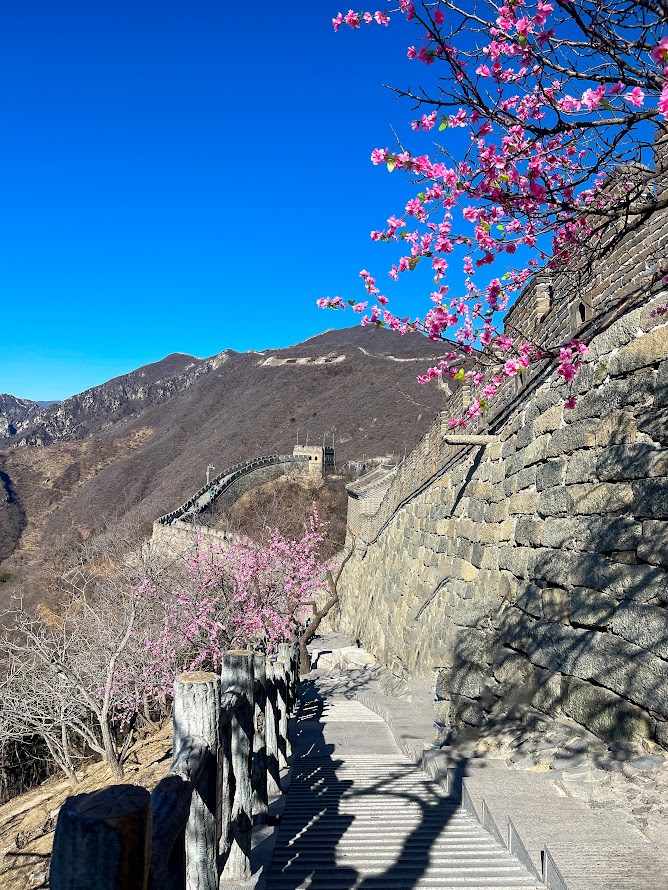
Standing atop the Great Wall of China, I was in awe of the resilience and determination of the people who built it over 2,000 years ago. The sheer effort of carrying bricks up the mountains to construct such a massive structure for protection is beyond imaginable. Yet, despite the challenges, they succeeded, and today, the Great Wall still stands—vast, towering, and seemingly endless. It’s incredible to think how they accomplished such a feat, and I have immense respect for the courage and dedication of early civilizations.
Luckily, the crowds were minimal, allowing me to fully take in the experience. I took a cable car up to the East Tower, then hiked and walked along the Wall. It was much more exhausting than I expected just getting there was a workout but every step was worth it. I felt an overwhelming sense of joy and accomplishment. What once was just a lesson in my primary school history books was now right in front of me.
Visiting the Great Wall is unforgettable. If you love history and architecture, you will fall in love with Beijing.
I took the toboggan down, and it was such a fun experience! I did have to stop a few times because I wasn’t maneuvering it perfectly, but that just added to the adventure. I highly recommend trying it, such a great way to end the Great Wall visit!
After the toboggan ride, I headed to the West Tower, the other side of the Great Wall. There were a lot more people there, but it was still worth seeing. Personally, I preferred the East Tower over the West.
After the exhausting walk and hike, I grabbed lunch at Burger King. It was quite pricey compared to the Philippines—I ordered a angus burger, Coke, and fries for PHP 600. Given the cost, I’d definitely rather eat at local food spots than fast food while in China!


After The Great Wall of China, we headed over to the Summer Palace in the afternoon. We rode a bus going there.
The Summer Palace in Beijing is a masterpiece of Chinese landscape garden design, seamlessly blending nature and human craftsmanship into a harmonious whole. As China’s largest and best-preserved royal park, it has had a significant influence on Chinese horticulture and landscape architecture. Its breathtaking scenery and rich cultural heritage have earned it the title of “The Museum of Royal Gardens.”
Yiheyuan or Summer Palace perfectly showcases the elegance and grandeur of imperial gardens. Centered around Longevity Hill and Kunming Lake, it features over 3,000 ancient man-made structures, including pavilions, towers, bridges, and corridors. Thanks to continuous government protection, the Summer Palace has retained its original design, layout, and landscape, making it a truly timeless treasure.
The Summer Palace was incredibly vast, and after a long day of touring, I was so exhausted that I decided to head back early around 4:00 PM—I just didn’t have the energy to explore a huge palace anymore! Haha!
That said, I really admired the architecture and the lake surrounding the palace. It’s a beautiful and relaxing place to visit. If you plan to go, I’d recommend going in the morning, as it tends to get more crowded in the afternoon.


Winnie WeChat-ed me to recommend a popular movie in China at the time—Ne Zha 2. She suggested I watch it, so I booked a 3D screening at 8:00 PM at SoShow Cinema in Beijing, which was conveniently close to my hotel. However, when I arrived, I realized there were no English subtitles! Thankfully, they refunded my ticket—xiè xiè!
I later got to watch Ne Zha 2 in a Philippine cinema, and I absolutely loved it! It’s a must-watch for anyone who enjoys animated films.


Since I couldn’t watch the movie, I decided to visit Qianmen Street instead and wow, I absolutely loved it! At night, the street lights up beautifully, blending the charm of old Chinese architecture with the lively atmosphere of street food stalls.
Walking through Qianmen Street felt like stepping back in time, as the buildings have been preserved to resemble those from the late Qing Dynasty, it’s like wandering through a living snapshot of history. There was also a tram you could ride, but I wasn’t able to try it since I couldn’t read the Chinese characters or figure out how to board. Maybe next time!
I ate at Quanjude in Qianmen Street. Quanjude is Beijing’s oldest roast duck restaurant, established in 1864, making it over 150 years old.
The name Quanjude is closely associated with Peking Duck, a famous Beijing dish loved by world leaders, government officials, locals, and tourists alike. The name itself has deep meaning: “Quan” means perfection, “Ju” means gathering, and “De” means virtue. Together, Quanjude represents perfection, unity, and kindness.
As I entered the restaurant, I was greeted by a row of chefs skillfully slicing roasted duck, showcasing the perfect technique. When my dish arrived, I was blown away—the skin was incredibly crispy, and the meat was so juicy. It was absolute perfection! I felt like I could fly!
I’ve never had Peking duck this good before, and only Beijing could bring me this much happiness through a single dish. I absolutely loved both the food and the experience. You can choose to wrap it with pancakes or simply enjoy it as is. My meal cost 2,000 PHP, as I also ordered sweet and sour peking duck, tea and snacks. On the bright side, the servers were very friendly even though we didn’t speak the same language, we still managed to understand each other!
I definitely would be back to eat peking duck again but only in Beijing!


After enjoying a satisfying meal, I caught the bus and made it back safely.
February 18,2025 (Tuesday)
Day5
I arrived early for our history tour of the Forbidden City and Tiananmen Square, which cost 2,535 PHP. The weather was freezing, with strong winds and temperatures dropping to just 1°C. Thankfully, we were given headsets, making it easy to hear our guide, Miko, who shared a wealth of knowledge throughout the tour.
This experience deepened my understanding of Beijing’s rich and complex history. Booking the tour was definitely worthwhile—not only did we skip long queues, but our guide handled all the details, making the entire experience smooth and hassle-free.
Over the course of the four-hour walking tour, I was fascinated by how China’s past has shaped Beijing and its culture. Some historical events remain highly sensitive topics, such as the 1989 Tiananmen Square protests and the iconic “Tank Man” image. Though these events are significant, they are rarely acknowledged in China. Naturally, our guide didn’t discuss them, as speaking negatively about the government could have serious consequences for locals. If you’d like to learn more about the Tiananmen Massacre, you can read about it [here].
Right across from Tiananmen Square stands the grand Forbidden City. Before stepping inside, visitors are greeted by the portrait of Mao Zedong, the founder of the Chinese Communist Party, displayed at the entrance. Our guide, Miko, shared an intriguing fact: Stalin, the former dictator of Russia, once had his picture placed beside Mao’s. That revelation took me by surprise, but it only added to the depth of this historical tour.
Exploring the Forbidden City was an unforgettable experience. Miko also mentioned that parts of The Last Emperor were filmed here, bringing history to life through cinema. As I stepped inside, I was completely awestruck—its sheer scale was breathtaking! It’s hard to fathom how a palace could be this massive. China’s architectural brilliance and rich history never fail to amaze me.
Also known as the Palace Museum, the Forbidden City sits at the heart of Beijing and once served as the imperial palace during the Ming and Qing Dynasties (1368–1911). Designated a UNESCO World Heritage Site in 1987, it remains the largest and most well-preserved ancient wooden palace complex in the world.
*Before entering the Forbidden City, our guide reminded us that alcohol wasn’t allowed inside. I jokingly said, “I have alcohol,” and he immediately looked concerned until I pulled out my isopropyl alcohol for hand disinfection. Turns out, the “alcohol” he meant was drinking alcohol.
P.S. In the Philippines, we call disinfectant spray alcohol, totally different kind of buzz


After wrapping up my Forbidden City and Tiananmen History Tour, I made my way to the MRT and headed to the Temple of Heaven on my own. Upon arrival, I paid the entrance fee of 28 Yuan (approximately 221 PHP) and took a short five-minute walk through a serene park lined with trees. The peaceful atmosphere set the perfect mood before I entered the grand Temple of Heaven complex.
The highlight of my visit was the breathtaking Hall of Prayer for Good Harvests. This magnificent structure, with its round roof and three layers of eaves, was where emperors once held sacred ceremonies to pray for favorable weather and bountiful harvests. As the oldest building within the Temple of Heaven, it holds immense historical and cultural significance. The entire complex is a harmonious blend of the Hall of Prayer for Good Harvests and the Altar for Grain Prayers, showcasing the architectural brilliance and spiritual traditions of ancient China.
The Temple of Heaven was a sacred site where emperors of the Ming and Qing dynasties conducted rituals to honor the heavens and pray for abundant harvests. Its design reflects the ancient Chinese cosmological belief that “Heaven is round and Earth is square,” with the northern section of the temple being semicircular and the southern section square.
As a masterpiece of Ming and Qing dynasty architecture, the Temple of Heaven stands as a remarkable example of ancient engineering and remains the largest ceremonial complex in the world dedicated to heavenly worship.

After exploring the Temple of Heaven, I made my way back to Qianmen Street—a place I absolutely adore for its vibrant atmosphere and incredible lineup of restaurants.
I indulged in some delicious grilled lamb skewers and treated myself to tea-flavored ice cream (despite its being cold that day , haha). Then, I headed to Fang Zhuan Chang, a renowned Bib Gourmand restaurant in Beijing, to try their famous Zha Jiang Mian.

The staff there were incredibly friendly, though communication was a bit tricky at first. In fact, they even gave me a free Coke as a lighthearted gesture because we were struggling to understand each other. Luckily, another staff member who spoke English stepped in to help, making the experience even more enjoyable!

After indulging in a delicious meal, I made my way to the charming, rustic Starbucks in Qianmen. They had their own take on a classic Beijing dessert—a treat resembling the famous strawberry candied snack. As I strolled along Qianmen, I couldn’t help but notice the many vendors selling Tanghulu, a popular sweet-and-sour delight made of skewered candied fruit.

I could hardly believe my time in Beijing was coming to an end, with Xi’an awaiting me tomorrow. Beijing has truly captured my heart—I know I’ll be back to explore more, try new experiences, and, of course, revisit Qianmen Street whenever I get the chance. This trip is definitely one for the books!
With that, I headed back to the hotel and called it a night.


Next stop Xian
Love,
Maria,sometimes,Niskie
Leave a Reply