Misty mountains, typhoon winds, and hidden trails—Sagada tested us and rewarded us with one unforgettable adventure. Curious how we survived (and had fun)? Read my blog!
Disclaimer: All views expressed on this blog are my own based on my own experiences and do not represent of any entity with which I have been, are now or will be affiliated
September 13 2022 (Tuesday)
Batangas, Philippines
I haven’t blogged in a while. I’m worried because my dog, Phoebe, has distemper virus, an infectious and deadly disease caused by a virus that attacks puppies’ and dogs’ respiratory, gastrointestinal, and nervous systems. She was hospitalized, released after three days, and has been drowsy since then. I sincerely hope she heals; I don’t know what I’d do without her.
Date of Trip: September 02-04
Sagada, Mountain Province, Philippines
23 degree Celcius
Because of its relaxed atmosphere and pleasant climate, Sagada has been high on my travel wish list since my return to the Philippines on December 24, 2020. People who have experienced heartbreak often praise it as a helpful tool for moving on with life.I didn’t visit with a broken spirit. I found a hidden gem of a location that is perfect for exploring caves, hiking, and chasingwaterfalls.
Sagada is a town in the Cordillera Administrative Region of northern Luzon. From Manila, the trip takes 11 or 12 hours. Because of its remote position and rugged topography, Sagada has remained one of the few areas in the Philippines that have maintained its indigenous culture.
To experience the coldest climate in the Philippines, adventurers flock to the sleepy town of Sagada, where they may go hiking, spelunking, or even learn pottery.
Transportation
I booked a tour from Vanlakwetsero. It is a Philippine tour agency. We traveled to our destination in a private van for 11 hours. I don’t suggest this agency because it’s pretty disorganized; instead of them notifying me of the details, I had to follow up with them. Sagada’s roads were winding and difficult. It will not be an easy journey, especially after you reach the steep hills of Baguio to Sagada, one of the Philippines’ most dangerous roadways.
Who can travel to Sagada
Sagada is accepting leisure travelers provided that they follow the standard health protocol. No medical certificates, S-pass, RT-PCR test or vaccination card to be presented to some establishments or checkpoints. But I suggest to always bring your vaccination card and for your protection, have yourself vaccinated.
Language
The locals speak English and Igorot.
Accommodation
Our host, Vanlakwetsero, arranged for us to stay at Hagar Homestay. Because of my preference for a single room, I must add Php1,000 a day to the cost of the tour package.The fee was quite high considering the quality of the homestay we had booked. My showers were freezing cold because the heater wasn’t working, and there was also times when there wasn’t even enough water to use. Where I stayed was not pleasant, and I would not recommend it. Because of the cooler weather in Sagada, no fans or air conditioners have been placed in the rooms.
Best Time to Visit
Like the rest of the Philippines, Sagada has two seasons – rainy (May-Oct) and dry (Nov-Apr). Being a mountain town, it enjoys milder weather with year round temperatures at around 18°C (64°F).
Budget
My budget for this trip is Php11,000. Php5,899 for the travel agency, transportation and accommodation, Php1,600 for the tour, Php960 pottery making and the remaining is for food.
What to Wear
Sagada has chilly weather, I’d recommend to wear clothing that makes you warmer especially at night. Please also bring blower as it is hard to dry your clothes and hair.
Day 1 September 2
Banaue, Ifugao Philippines
The Philippines were hit by Typhoon Henry, and I was afraid my solo trip would be canceled. However, the travel agency assured me that everything was safe to travel, so I set out. The journey from Manila to our first stop, Banaue, took ten hours and began at 9 p.m. on September 1 (a Thursday).
Banaue’s rice terraces, especially around sunrise, are a sight to behold; I never tire of gazing at their stair-like grandeur. Banaue Rice Terraces, sometimes known as the “8th Wonder of the World,” are more than simply a pretty sight; they were originally built by the Ifugao people thousands of years ago. For them, doing so is an integral part of maintaining and expanding their unique rice-based culture.


We drove the three and a half hours from Banaue to Sagada after visiting the rice terraces. We arrived at our homestay in time for lunch and a much-needed hour of recuperation.
We reached Sagada almost lunch time so we ate lunch first, went to our homestay and rested a bit.
Sumaguing Cave
Sagada, Philippines
Over 60 caverns have been discovered beneath the town of Sagada, with Sumaguing Cave being the largest chamber, earning it the nickname “The Big Cave.” Countless rock formations have been slowly formed by nature over thousands of years in the cave. The bear, elephants, mother and child, lover, and other formations are examples of this.
We started our exploration of Sumaguing Cave by descending a set of stairs built alongside the road. Since it had been raining a little in Sagada, the descent was particularly treacherous. As we proceeded further, we witnessed the remarkable rock transformation. Spelunking was a fantastically exciting and arduous adventure. I’ve done cave exploring before, in Krabi, but the rock formations in this cave in Sagada were far superior.
You’ll have to work your way through three increasingly difficult levels of the trail. The first portion was the climb down, the second was rapelling and rock climbing, and the third was a tunnel where you squeezed yourself in and jumped. We were unable to complete our journey since heavy rain prevented us from crossing flooded areas. To our relief, we were able to escape the building before the entryway was completely flooded. Next time I want to undertake the most challenging spelunking in Sagada, which occurs in the summer. It’s quite risky to be in a cave when it’s raining.


It rained heavily on our way out and we just decided to conclude our first day so I just ate, had coffee and sleep.
Day 2 September 3
Even though I awoke at 3 a.m., there was still a steady downpour. We were supposed to go on a hike to see the sea of clouds, but it was canceled. I slept again and awoke at 9 a.m. to begin the second day of the trip.
Sagada Weaving
Since 1968, Sagada has been weaving high-quality items such as purses, flip flops, and souvenirs. Many residents work here, and it is claimed to be one of the town’s main employers. If you want to buy traditional Sagada products, you should go here. I bought earrings and headbands here.
We had a brief glimpse inside their work hall; it was small and we were not permitted to take photos or interfere with the operations. I saw how they make the souvenirs on wooden weaving looms. I don’t think I could do it because it appears to be really hard and requires a lot of patience, which I don’t have haha. The items were skillfully woven.

Sagada Pottery
Our second destination was to the Sagada Pottery, which is more of a workshop than a storefront, and we learned the craft from master potter Siegrid Bangyay. The pottery has been the town’s center for pottery manufacture since its founding in 2001.
The shop charges P100.00 for a group and P100.00 for each person who wants to try their hand at pottery. I volunteered to create a bowl and bought what I made to help the locals. It was an incredible experience! Finally, I tried my hand at pottery! *Update – The bowl I made was finally delivered to me, and it was awesome.

Echo Valley Tour – St Mary’s Church, Mission Cemetery, Echo Valley -Hanging Coffin
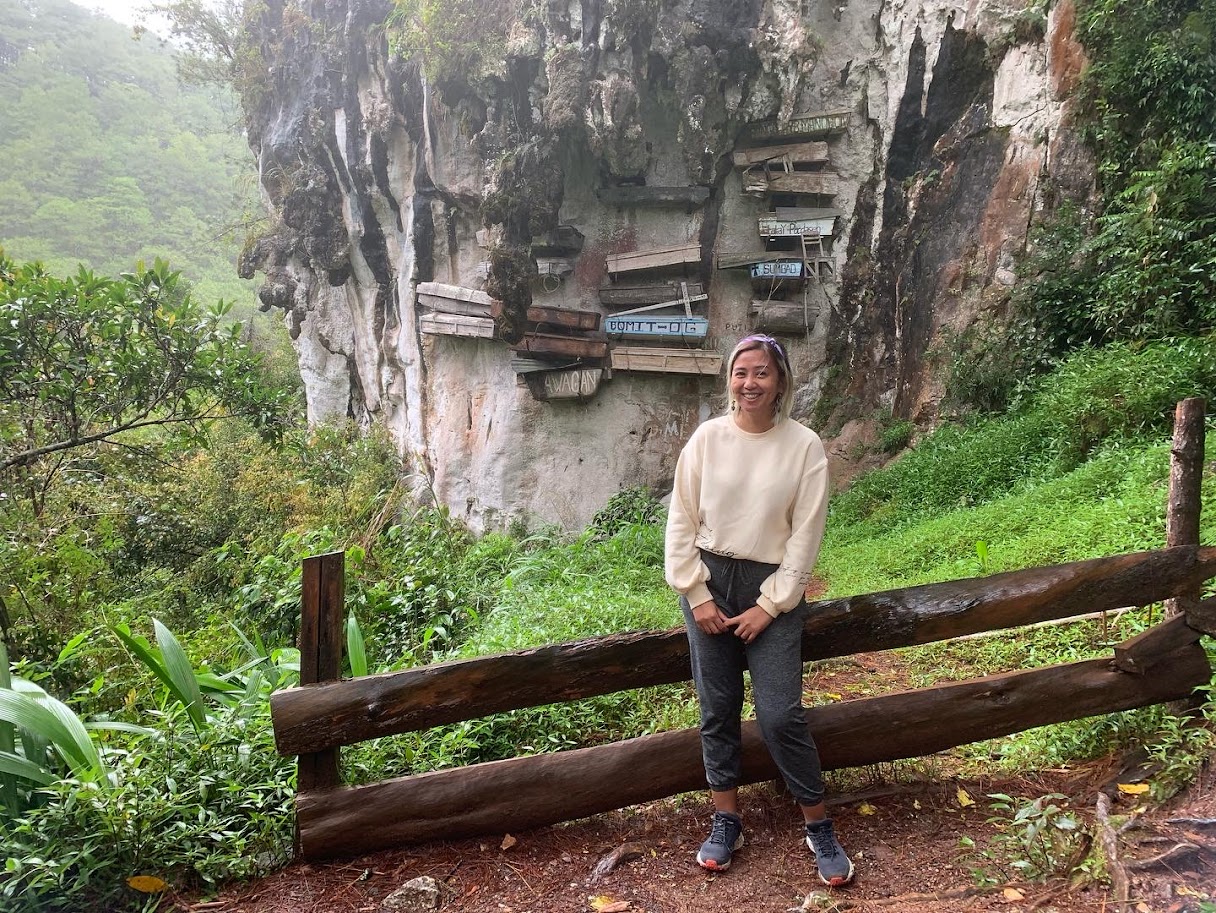
Echo Valley is famed for its landscape, which includes sheer cliffs with dangling coffins attached to one edge. They say that if you travel to the Echo Valley, you can shout and it will reverberate, hence the attraction’s name. However, we were unable to do so since guides advise keeping the area quiet as a mark of respect to the dead and instead enjoying the landscape.
To get to Echo Valley and the hanging coffins, we walked past Sagada’s town cemetery part of Mission Compound where they buried their dead, located on top of a hill. Instead of candles, they use mini bonfire to honor their dead.
The hanging coffins are located about 15-20 minutes downhill. The Igorot people or residents in Sagada, Philippines, conduct an old burial tradition in which the elderly carve their own coffins and the dead are hung from the side of a cliff. Before being placed in the coffin, the corpse is placed in a wooden ‘death chair,’ which is secured with leaves and vines and covered with a blanket. The body is then smoked to prevent it from decomposing as relatives pay their respects over the course of several days. The Igorots believe that a person should leave the world in the same manner in which he entered it.
St. Mary’s Cathedral was our final stop, a church erected by American Anglican missionaries who arrived in Sagada in the early twentieth century. Despite their conversion to the Anglican religion, many Sagadans maintain their pagan beliefs.


Trekked at Pongas Falls
It was a trip unlike any other in terms of difficulty. On my way up the waterfall, I nearly lost my footing among the boulders. When we arrived, it was pouring rain. The trail was treacherous, complete with cliff edges, a hanging bridge, and rice paddies. Once I found the waterfalls that were tucked away among the massive rocks, I realized that I was witnessing the true splendor of nature. It was also very soothing to swim in the cool pool formed by the cascading streams.

September 4
Sunday
We were supposed to start our hike at 4:30 a.m., but I woke up at 3 a.m. It was incredibly annoying that the homestay didn’t have running water, but oh well, I had to get out there and hike anyhow, haha..
Marlboro Hills
Hiking up Marlboro Hills, Sagada’s highest peak, only required a day of effort. It got its name from an old Marlboro ad featuring cowboys riding their horses up a hill. Locals also claim that this area was formerly a haven for mountain horses, who were commonly used as transportation. It was cloudy, so we missed the sunrise and its accompanying sea of clouds. Although I prefer the view from the summit of Mt. Pulag, I would still trek in the Marlboro Hills if I ever returned to Sagada because of the pleasant weather and beautiful scenery.


Blue Soil
We spent half an hour in the Marlboro Hills before beginning the 30-minute trip to Blue Soil. Kaman-Utek, or “Blue Soil” to its native speakers. The Blue Soil Hills of Sagada are a series of miniature hills whose soil takes on a distinctive blue-green hue when it rains. A high concentration of copper sulfate causes a change in soil color. It has been hypothesized that adding more water to the soil will cause the blue hue to become more pronounced.
The hour-long descent was over rocky and muddy ground. There were some very slick and muddy descents. The rest was made up of craggy limestones. This was the steepest downhill I’ve ever made, and I was ready for it to be over. The scenery was beautiful, with pine trees dotting the entire descent. while sharp limestones predominated in other areas. Unfortunately, I was underwhelmed by the Blue Soil once we got there. Even though I made it here through the muck and the slippery rough path, it was all for nothing. It was nice to see it once, but I don’t want to risk my life again simply to see it.


Sagada Eats
Sagada is a paradise for foodies thanks to its abundance of delicious regional delicacies. The restaurants also had a cozy, welcoming vibe, which was a plus. Sagada was home to the best meals of my life; I can’t wait to return.
Lemon Pie House
Atey, Dao-Angan, Sagada
Php50-Php200
Accepts Cash only
I heard a lot about good things about the famous lemon pie here but I was quite disappointed when I had a taste of it on my own. It was not citrusy to my taste, the crust was soft and the over filling was not sweet and buttery. Probably their egg pies tasted better and I should try that next time but I am not a fan of their lemon pies.


Salt and Pepper
Dagdag, Sagada
Php150-Php800
Accepts Cash Only
Salt and Pepper was very hard to spot as their signage was not that visible in the road but it’s a find that I would recommend to all my friends. I love Salt and Pepper and this is one of my favorite restaurants in Sagada. They offer variety of local delicacies which were so deliciously and heavenly appetizing. This is a must whenever I will visit Sagada.
Pork Etag Sisig
I tried pork etag sisig and it did not disappoint. It was savory and fatty flavors from sizzling dried and salted pork. Etag is the Igorot’s traditional way to preserve the dried and salted pork that can last for a week or months when it’s sun-dried. It is kept underground in an unearth jars. The locals believe that by using wood to smoke Etag can bring more aromatic flavor to the meat.
Dinakiw
It is a pan-grilled pork with onions. This is pan-grilled in perfection. Flavorful, meaty and heavenly. I’d always go back and try this dish, highly recommended


Sagada Brew
Php150-Php600
Accepts Gcash and Cash
Sagada Brew only not caters to coffee but famous local dishes in Sagada. I loved their coffee, juices, pasta and Sagada’s Pinikpikan. I have dined here for breakfast, lunch and dinner. One of my favorite restaurants in Sagada as it’s very near our homestay – 2 minutes walk.
Pinikpikan
Pinikpikan is a controversial dish. The soup consists of chicken and etag. What makes this dish controversial is how it’s prepared. The chicken is slaughtered – it is gently beaten to death with a stick in a ritual performed by local tribes without breaking the skin or bones. This process bruises the chicken giving the skin a different texture and flavour as they say. Once the “pikpik” process is completed a single hard blow to the back of its head or neck is used to end its life.
Even though, the process was tragic, I was really impressed of the taste of this dish. I surprisingly liked it so much that it was the best chicken soup I have ever tried. I don’t like how the process is done but this is part of Sagada’s tradition and culture.


Yoghurt House
Php100-Php400
Accepts Cash Only
I never really liked yoghurt but this is the best yoghurt I have ever had in my life and will never ever get tired of going to Sagada just to have a taste of this yoghurt. It has a smooth and creamy texture with tangy flavor with a slightly more sour taste. I will try other dishes next time when I visit Sagada again.


Bana’s Coffee
Php200-Php500
Accepts Cash or Gcash only
Bana’s coffee offers variety of breakfast dishes and coffee. They serve huge portion of dishes and it’s flavorful and aromatic coffee.


Gaia Cafe
Php200-Php300
Accepts Gcash and Cash
I walked 15 minutes just to see and taste the food in Gaia and to be very honest I was disappointed. I liked the interior and the view but the food tasted bland and not worth my 15 minute walk. They cater to Vegetarian dishes but I’ve had better Vegetarian dishes somewhere else. This was my least favorite of all the food spots in Sagada.


Pitik Wines
Php200-Php500
Accepts Gcash and Cash
This is just around 4 minutes walk from our homestay and it’s a quaint clay house wine shop. I love to try local alcohol whenever I travel. I talked to the owner of the shop and learned a lot about their humble beginnings. They started in 2004 so the wines are still fresh, wines are better when aged. I love their tapey or rice wine, it’s light and sweet just how I like my wine and I brought Bugnay for my brother, it’s stronger with 13% alcohol content.

I love Sagada and will always go back to this laid back place. It’s a must see for locals and foreigners. I will always go back to Sagada.
Love,
Maria, sometimes, Niskie
Leave a Reply